Saturday, December 9, 2023

Tis the Season: For $90 Fraser Firs


Charlie Brown and Linus at the Christmas Tree Lot

Sorry, Charlie Brown. There are no trees for you at the local lot.

Even folks who sell trees call the spindly ones with a bad side "Charlie Browns," but they are hard to come by. I saw two prices today outside Pleasants Hardware: $74.99 and $94.99. I recall $5 trees on Christmas Eve, whenever possible Scotch Pines, our family favorites. We usually put up the tree Christmas Eve not out of tradition, but to save money. Mine was not a wealthy family in the late 1960s.

Today, a hundred bucks. Gulp. We have not bought a live tree in many years, preferring a Cedar we cut from our land. We remove crooked saplings and selectively thin to promote a healthy woodlot and reduce fire hazards every winter, as soon as the frost means not stepping on a Copperhead. At the edges of the woods, Red Cedars abound, and if they get sun, they usually have only one bad side and a lot of branches.

That may not be an option for many readers. Let's say you don't want to spend a bundle on a cut tree but want something nice-looking and sustainable.

I'd actually argue for a few ideas different from typical Christmas trees today. In fact, some of my ideas once marked the fad of their era.

1) Go Lucy van Pelt, not Charlie Brown. We bought, in a moment of irony, a silver tinsel tree. It's only 2' tall but it evokes childhood memories of the basement of Standard Drug in what is now Richmond's Carytown. The basement was only open in those years for the holiday season, stocked with toys and a lot of aluminum trees in one corner. The drug store put out a really nice winter wonderland, with fake snow, lots of ornaments, and colored lighting. It was magical to a kid, especially blue lights on the silver trees. The whole idea of metallic trees fell from favor for many decades but now it's BACK. Mind you, today's fake trees are Chinese made, not from a factory in Hoboken or Sheboygan or San Diego. 

2) Spend a lot on a really nice artificial tree. Not in the mood for a shiny pink aluminum tree, Charlie? A quick look online to find realistic-looking green trees ranging from 200 to 2000 dollars. To be honest, the mid-range ones appear fantastic. Look for ones that are not too regular; I saw a tree for nearly $2000 that had every branch shaped identically. Real trees do  not look that way. Once  you find the right tree, however, it could last you decades. Amortize a $400 tree and you might spend 20 dollars for each of 20 seasons. That's a quarter what a tree-lot example costs, without inflation. Like my tinsel tree, these trees do not need water and won't drop needles.

3) Plant a live tree and decorate it outside. If you have the yard for it, a 6' evergreen can come your way for under $150. For five years or so, until it gets too large, you can add lights and all-season decorations. If it's a dwarf conifer, you might be able to make it your Christmas tree for decades.

4) Get Your Goose (Feather). There's a German tradition of the "Goose Feather Tree" I only learned about today. Take a gander with Mr. Google or Mr. Bing or that Duck Duck Go fellow. The original Goose-feather trees were created by dyeing feathers green to simulate branches, then attaching them to a trunk. You can buy them ready to assemble today, at decent prices. They don't have the density of Fraser Firs, but the sparse branches let you show off large ornaments.They look quaint and cozy to me, like a Walton's tree John Boy brought down the mountain.

5) Become a Druid. A friend who studied modern-day Druidry had a bare branch in her home, beautifully decorated. It evoked the slumber of our current season. It was striking to see and when Yuletide ended, it could go in the compost or wood stove.
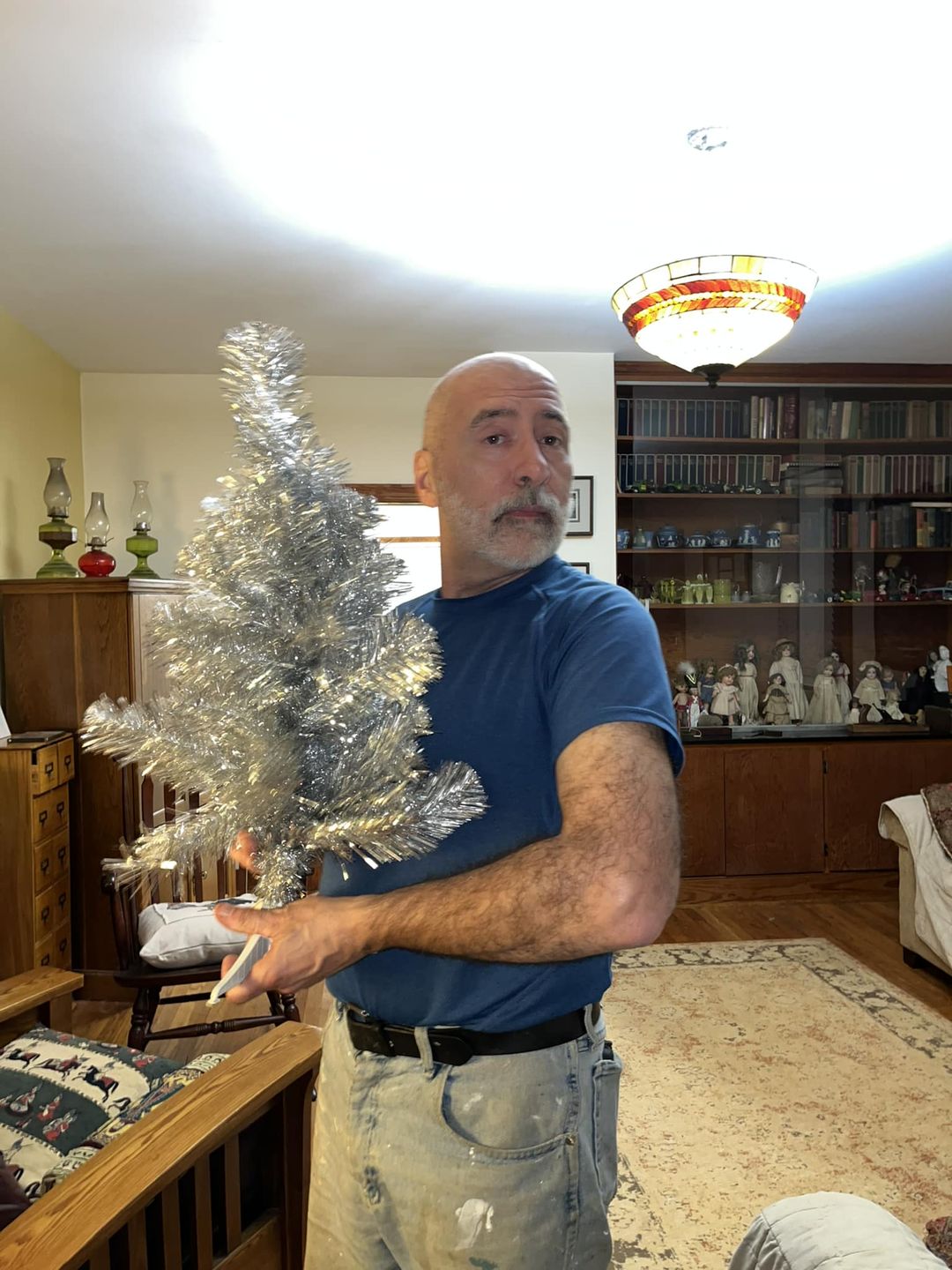
Me with tinsel tree
I am out of ideas.  But have a tree, whatever your faith. It's a wonderful tradition. A Blessed Solstice, Happy Hanukkah, and a Merry Christmas to  you.


Sunday, November 26, 2023

Keeping Our Security System Local (For Now)

Antique Burlar Alarm

I cannot live without a home alarm system. It's just how I roll. Now in the country, it's good to have it include fire notification as well.

Several years ago, after a lightning strike blew up our home security system, the then-giant security firm ADT revealed that it had begun to act arrogantly toward residential customers. We said farewell and went with a locally owned firm, Richmond Alarm. They installed a new control pad, surge protector that ADT neglected, and lower monthly monitoring fees.

I consider a good home-alarm system as essential to my peace of mind as clean water. Richmond Alarm had been around a century and seemed unlikely to be going anywhere.

Then they vanished. An out-of-state firm purchased them and swore nothing would change. Within a year, an internationally owned company called Johnson Controls took the helm, outsourced customer service to an Indian call center, with nice but poorly trained workers who read scripts. I began to get voicemail reminders multiple times monthly from India, reminding me to pay my invoice. I blocked all the numbers.

I've never missed a payment, and we auto-pay. Meanwhile rates went up and local employees got the boot.

Now we are about to give Johnson the big farm boot. We considered DIY options from Nest and Ring, but in the end, our setup is complex, covering out-buildings and our home, while our data caps low. We lucked out finding a firm whose headquarters is a few miles from our farm. They can reuse most of the Johnson hardware and upgrade a few dodgy sensors to communicate with our control panel and phone apps.

All that with no hit on our puny WiFi internet data caps.

The moral here? If you live rural without broadband and need a security system, your options may be limited. Starlink's base plan provides 2 TB of data a month, as compared to Verizon's 100 GB. We don't stream media except a movie every few months. We don't watch TV series (unless we can get a DVD). The guy from our new provider looked at us like we were from outer space, but then he said "Starlink would be perfect for you if you add a doorbell camera." 

That may be down the road, or even a DIY setup. Security systems are not cheap, and monitoring is a monthly expense, but the price of a break-in is years of trauma.

Right now, I'm thankful to have a local option again. And I'll be in line for a Starlink antenna.

Image courtesy of Lorie Shaull at Flikr

Saturday, November 11, 2023

A (Darn Straight) Right to Repair

Closeup Tire Rotation

 I have begun using the term "stealership" when referring to the automotive dealers' service centers.

Granted, I know some dudes at Mini, and they have given me sweetheart deals over the years. They knew I'd be coming in to buy another car, eventually. Granted, I used to know a tech or two at Honda, before I got the chops to fix on my own the two CR-Vs I've had. But, still.

 With my wife's 2019 Toyota Tacoma due for its first non-free service at 30K miles, I asked her to get a price on the work: oil change, filters, checking differentials and transfer case, lubing the few points on the chassis that are not sealed. Price? Nearly 300 bucks.

"Get out," said I, looking at the owner's manual. I knew that I could do the same work for a lot less. I made a list, because modern companies still give you a maintenance schedule in your owner's manual. Use it.

The 30K Repair list

This post is not a "tsk tsk" for those of you who don't have tools or time to DIY maintain your rides. I have been blessed with an inherited lift we got back in service last year, time to learn how to use tools, plus a decent collection of same. I write for an automotive publication. I should be able to turn a wrench by now.

My family was famous for its mantra "call some guy!" I've written recently about this philosophy. My mom's brother-in-law, Carlyle Rourke, resisted it. He had a 1964 Mercury Comet 4-door that he kept into the late 1980s. He did everything on that car, and when my first Buick Apollo needed an oil change, he showed me how. My old man told me "get a real mechanic to check your work, boy." I told Pop that if the car was not puking oil into the street, and the dip-stick was right, I'd just take my damn chances.

Today's vehicles are a long way from that Comet, but there are many things one can do on modern vehicles, and thank you, YouTube mechanics, for showing us how. For Nan's truck I soon had torque-specs for all the bolts I'd need to tighten, techniques for doing things without spilling oil on myself (here I failed. Toyotas are odd that way), and so much more that would put you to sleep if I listed them.

Like the OCD person I am, I wrote it ALL down in order of service, with numbers for torque specs beside each item on the 30K list.

With three hours of backache-inducing work, it all was done. I did have to order sockets from Amazon in sizes I didn't have. I tried local businesses but they either put me on endless holds or told me I'd have to buy a set.

Pffft. I got next-day delivery from Bezos' company and a good price. At the end, for $76 including the half-case of Amsoil 0w20 plus filter and Toyo-specific filter-wrench I needed for the oil change, I handily came in at 1/4 the price of the dealership.

Now that many states are pressing for right-to-repair laws, may I humbly suggest you go to Harbor Freight or Northern Tool, buy a cheapass set of wrenches, and watch some YouTube videos? See a few how-to examples at other sites? Some of them have wonderful senses of humor.

Smart-ass Internet advice for fixing the car, but accurate!
It's the 21st Century version of sticking it to the Man. Come bust a knuckle or two with em.

Friday, October 20, 2023

A Cylon Provides Homesteading Advice

Robot Cultivator and Human Worker

Some time ago I picked up a booklet from an extension agency for first-time homesteaders. So I decided to see what an AI might say on this topic. I'm actually impressed. It provided answers "tailored for your tractorpunk perspective"but it's a better caretaker of the land than most humans I know. 

It also covers all the things we have done, sometimes after mistakes, or are planning to do with our land.

Okay, the blog is done. I'll just let  you ask an AI from now on :P

Joe: Good afternoon. I'm going to do a post at my blog Tractorpunk.blogspot.com and am curious about what advice you might synthesize for a new homesteader moving to a rural area. I figure a machine would have some good ideas because tractors are machines, too.

ChatGPT: Good afternoon! Moving to a rural area and starting a homestead can be an exciting and rewarding adventure. As a fellow machine enthusiast, I'm happy to provide you with some practical advice for new homesteaders based on the principles of machinery and efficiency. Here are some tips tailored for your tractorpunk perspective:

1. Research and Plan Like a Well-Engineered Machine:

Survey the Land: Understand the lay of the land, soil quality, water sources, and microclimates. This knowledge will help you plan your crops and animal husbandry effectively.

Set Clear Goals: Define your objectives clearly. Are you focusing on sustainable farming, self-sufficiency, or maybe even a small-scale agricultural business? 

2. Prepare the Ground for Planting:

Soil Testing: Conduct soil tests to determine its health. Tractors need solid ground to operate efficiently, just like your plants need healthy soil to grow well.

Composting: Start composting organic waste to create nutrient-rich soil. It's like fueling up your tractor with the best quality diesel.

3. Choose the Right Seeds and Livestock:

Diversify Crops: Plant a variety of crops to ensure resilience against pests and weather fluctuations.

Livestock Selection: If you plan to have animals, choose breeds that are well-suited for your climate and have a low impact on the land.

4. Implement Efficient Farming Practices:

Crop Rotation: Just like rotating tires ensures even wear, rotating crops maintains soil fertility and reduces the risk of diseases.

Rainwater Harvesting: Install systems to collect rainwater. Water conservation is vital for any farm, just as fuel efficiency is essential for tractors.

5. Embrace Sustainability and Self-Sufficiency:

Alternative Energy: Explore solar power and wind energy. Just as tractors are becoming more eco-friendly, your homestead can too. 

Preservation: Learn techniques for canning, fermenting, and drying food. Preserving your harvest ensures a year-round supply, much like storing fuel for the seasons when your tractor needs it most.

6. Community and Knowledge Sharing:

Local Networks: Connect with local farmers and homesteaders. Sharing knowledge and resources is like having a community of well-maintained tractors—you all help each other out.

Continuous Learning: Stay updated with the latest agricultural practices and sustainable farming techniques. A well-maintained tractor is a knowledgeable one!

7. Maintenance and Care:

Regular Inspections: Just as tractors need regular check-ups, inspect your crops, animals, and equipment regularly.

Adaptability: Be prepared to adapt your strategies. Just like a tractor that can handle various attachments, your homestead plans might need adjustments based on experience and changing circumstances.

8. Safety First:

Protective Gear: Just as you wear safety gear while operating machinery, prioritize safety on your homestead. This includes proper equipment use, fencing dangerous areas, and having a first aid kit on hand.

Remember, every successful homesteader started with a passion for their land and a willingness to learn. Your journey, much like a well-maintained tractor, will get smoother with time, care, and a bit of mechanical ingenuity. Happy homesteading and blogging! If you need more specific advice, feel free to ask.

Joe: Dang, son, you sound like a farmer! If you were in a Cylon Chassis I'd hire you.

ChatGPT: Thank you! I'm here to assist and provide you with the best advice possible. While I might not be in a Cylon chassis, I'm always here to help you with any questions or tasks you have. If you have any more inquiries, whether they're about farming, blogging, or anything else, feel free to ask. Happy homesteading!

Robot cultivator courtesy of Wikipedia Commons.

Thursday, September 28, 2023

Call Some Guy? When Do You Do That?

Water filter
After the remnants of a tropical storm brought 5 inches of rain to us in two days, our well-water again grew cloudy. Our well-house, below ground level, had flooded. 

Living with a well is always an adventure

Was it time to call some guy? My old man, whose tool-kit consisted of a claw-hammer and 16D nail, would say that if those two items did not fix something. "Boy, we better call some guy!"

I have done this thing myself, DIYer that I am. We have had this water issue before, after an earthquake (!) knocked a huge chunk of concrete out of the well's casing. Silt would pour into the well with heavy rain. I called some guy.

That time we spent thousands of dollars to get the casing repaired. Those repairs included a pallet-load of cement to fill a void as large as a closet and a UV filter installed for the water line. 

This time, we rode it out. Here's why.

Rural life involves lots of trade-offs, not least of which involves the expense of getting work done by others. Most of the time, to save money and remain as self-reliant as possible, we "make do or do without," so we have filtered water for a week as the ground-water level dropped. 

The well was, after all, undamaged. To have a firm come out and pump out the well house would cost a lot of money. I have a jet-pump, but I also have a day job that has gotten very busy of late. So out came the water filters for camping. 

No amount of self-reliance equates to self-sufficiency, a pernicious American myth I've critiqued here before. I put down my test of tests to this: is the cost of the repair vs. the time I'd need to do it myself so high that I am willing to surrender X hours of my time, bust knuckles, maybe risk an injury?

When the answer is "yes," I get out the tool box. If "no," I call some guy. That is not a defeat, but it's also not an invitation to be helpless and not learn skills.

No offense, but when something minor goes wrong at the rental property, my tenants never fix things that I can fix in ten minutes. First, they have me and I work just up the street. Second, there is fear of making something worse. My current tenants have some "skills" and can at least diagnose problems. I've had others without even a screwdriver or pair of pliers in the house. It's a form of learned helplessness I simply do not understand, but at least the rent gets paid by these good folks.

So learn some skills, but learn your limitations, too.

If you are an entrepreneur, I strongly recommend setting up a handy-man firm called "Some Guy" with the motto "Got a home problem? Call Some Guy!” That’s 1-800-Some Guy or  callsomeguy.com." 


That URL is not taken, so get busy. There's a fortune to be made.


Thursday, September 7, 2023

Figs, Figs, Everywhere

Fig Jam

My grandfather Sam spent most of his life trying to grow figs, before climate change made it ridiculously easy in our bioregion.

That is the one good thing I will ever say about global warming.

This time of year, my nephew Mike Ryan (as big a madman as I am) will text me with a "hey, Uncle Cheapass! I want them damn figs!" and I deliver, delighted that one person in my extended family at least loves fresh figs as much as my grandfather and dad did. Or as much as my wife and I do now.

Growing fig trees is not that hard, once they get established. Chicago Hardy is a variety that works well here. Further south Brown Turkey is a good bet.

But what to do with the thousands--and I am not kidding--of figs that even four trees can produce in a year? Here's the plan, Stan.

 And where do we go for ideas about how to deal with lots of excess fruit or veg? Why the National Center for Home Food Preservation, of course!

They feature the best canning recipe ever for fig jam. Even non-canners could make this one work. It cans in a boiling-water bath in 5-10 minutes, depending upon the size jar.

We have not bought jam in years, in consequence. Plant some fig trees and give it a try. Sam would be so happy to know that folks are growing figs. Once you get in the habit, you'll never let it go.


Thursday, August 17, 2023

That Mighty Fine Old Hose

 Joke coming. Leave now if you wish.

"How many Virginians does it take to change a light bulb?"

"Only one to change it and five more to talk about how mighty fine that old bulb was!"

Old Garden Hose, coiled up

Lots of truth here. So when a 40-year-old garden hose finally gave up the ghost, I had my next blog post.

My father passed 21 years ago, and that seems like yesterday. He bought a house in 1975, on Fitzhugh Avenue in the near West End of the City of Richmond, and I only lived there for four years before college, but I came back for a year and a half after. Those were very happy years for us all. About that time, in 1984 or so, he redid the yard and went to a local hardware store. He bought the best garden hose they offered. "Real rubber!" he said, still house-proud a decade later. He as no yard-guy, but he believed in keeping up appearances on a block where the neighbors often went all-out for their little 1/3 acre city yards.  That hose was astounding; it coiled up naturally without kinks and was easily to move around.

Yes, a mighty fine hose it was.

I miss the old man immensely, for all his difficult personality tics. After a life of hard toil behind the wheel of a truck he'd made it, owning a produce warehouse with his cousin Leroy. He was a beloved boss, too. Maybe he treated his employees so well because he remembered terrible privation.

He grew up in desperate poverty in the Great Depression, served in the Navy during World War II, raised a family with my mom in a little row-house. A detached two-story home in a neighborhood full of assistant bank-managers and insurance salesmen, with an Olds or Buick out front? The American Dream. I miss that too. It's gotten so super-sized since dad's day. I am rather glad he's not around to see things now.

That old red hose? It moved with us after mom passed away, and I used it for years until we moved to the country in 2012. Then it served well in our garden, with some fraying finally catching up to it near the end. I used a special leak-stop tape but that only bought me a  year. This summer, the old hose had to go.

Why do we fret over material things so much? In my case, that old hose told a story that only mom and I knew, and maybe my oldest sister. Sis and I are the only ones left. Now I am telling you.

Funny thing, though. This tale has an ending not only happy but sustainable. We found that most of the old hose is just fine, still flexible and intact as ever. I cut off 10 bad feet or so, then another 20 good feet from the far end. That length will help me water trees, attached to the water tank I carry around in my UTV for saplings when the weather here goes into a prolonged dry spell.

Water hose and tank on back of UTV


If the hose lasts four more decades, it will outlive me. And there the story will end, happily in fact.


Some Sad Thoughts About Using Roundup (And Why I Do)

A piece  about weeds appeared in the New York Times recently and readers erupted when the article's author mentioned the usefulness of ...