Showing posts with label Beepasture Farms. Show all posts

Friday, December 27, 2024

What a BOIR from the Feds

Federal Shield

It's enough to make me a Libertarian. 

After having filed papers dutifully for years with our State Corporation Commission, I now understand that the Federal Crimes Enforcement Network, under threat of fines, will make LLC owners file even more paperwork. It's a free process but a tedious one, and the online interface is predictably awful in a manner only the Federal Government could design. It did not let me file because the portal would not let me click the final "I agree" button. With some efforts, I used method B and sent them a PDF filing.

Yes, it makes one wish--almost--for the giant axe coming in January for lots of Federal agencies. I just wish I could pick which ones to cut.

The madness for small farmers and other businesses comes from something called The Corporate Transparency Act. Sounds good on paper; we don't want firms hiding illegally obtained money. That said, large corporations can give unlimited campaign funds to candidates, anonymously, since the People United decision by our Supreme Court. I suppose that legal largesse does not extend to little LLCs.

A Texas court blocked implementation of the plan, noting that "The CTA, by its very language, does not regulate any issue of foreign affairs. It regulates a domestic issue: anonymous existence of companies registered to do business in a U.S. state and their potential conduct." I sighed in relief.

 But then our extension agency noted that the stay had been lifted, and we had to file. Yet on the Federal site, it said, essentially "oh, don't file yet until the court case gets decided. But you can file."

Then, my tax guy's office said it's been halted again!

So I filed anyhow and I got an official-looking certificate from Uncle Sam. Our little LLC is honest and not laundering money. We have nothing to hide from any state or Federal agency.

I'm hoping that one day the horrible People United decision will be reversed, and laws like the CTA struck down as unconstitutional blocks on interstate commerce.

Governments build good infrastructure. They protect us from foreign and (we'll see in 2025) domestic enemies. They protect, in theory, our natural spaces.They assure minimum common standards. I like the green cash money they print, too.

But making little farms like ours file above and beyond what the State of Virginia asks seems burdensome and meddling. Here's to The CTA getting struck down for good and little folks, not just huge corporations and billionaires, having some say again.

Wednesday, March 27, 2024

When Retirement Nears, Making Plans

Back in 2017, I attended a workshop at a national conference in Portland, Oregon. We were there at the national meeting to discuss writing pedagogy, but I figured I was within 10 years of retirement. I then went to a session on how we find meaning when our day jobs end.

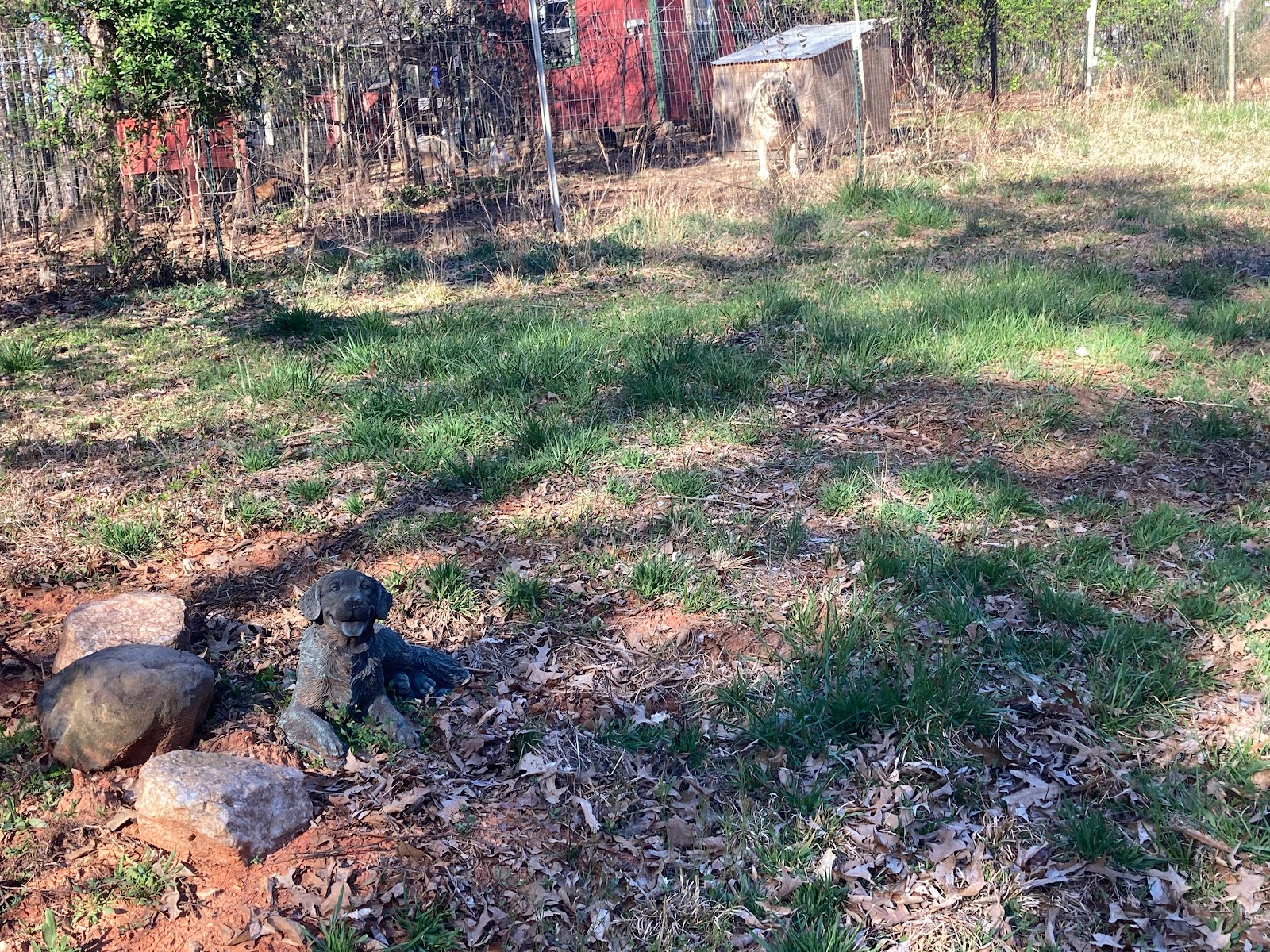
The other day, 3 years ahead of schedule, I notified my employer that I'd be ending full-time work for the university at the end of the year. I'd just harrowed the hillside below the spot shown above; we'd buried our first livestock guardian dog, our beloved Vela, at the top of the hill. Life is short. In 2017, Vela had been with us 2 years and was in her vigorous middle years. Now, she's resting.

Big decisions when to retire are naturally fraught with emotion, but honestly, it was the happiest decision I've made in a long time. I don't hate my job or colleagues, but unlike many of them, I have a Plan B waiting. It differs from many retirement plans I hear such as "I'll travel more" (great!) or "I'll be more active in my church or community" (fine!).

I'm neither religious nor able to travel as much as other academics do. Luckily, I find my joy in work with words, machinery, and plants. For so many years, I realized that I love the solitude and hands-on experience of writing, gardening, forestry, and tending to land. I'm happiest on a tractor for many hours on end, coming in the house to share lunch with my wife and discuss what we've been doing that morning. My favorite pastime involves fixing and maintaining machinery and equipment; I find it much more rewarding than dealing with the messy intricacies of classroom or office. I'm getting more social, because it's healthy, but generally, others wear me out. 

As my late father-in-law put it, when done with a task "I like something I can put my hands on."

In Portland we discussed how a mere hobby would not be enough to fill the hours that require intellectual company. My farm-work is not a hobby in the same way as, say building models or restoring an old car, but I got the message. I took it so to heart that after the conference, I began a book project that saw publication in 2019. Nowadays, my plans are less grandiose, but I plan on more fishing and hunting. Those hobbies are great fun but don't quite fill the bill for a healthy retirement.

Having given lots of thought to this transition since 2017,  I'd advise any of you thinking of joining me in the long twilight of a working life to take stock of what brings you joy physically, emotionally, and intellectually, especially as your physical abilities will begin to taper off. A guy named Mr. John Deere helps with that, to a degree, as I find it hard to hire day labor, even for $20/hour in cash plus gas money and lunch. But no pay will buy me intellectual debate over a lunch table.

For that reason, I plan to teach part-time in retirement in my university's Master's Program for continuing students. Most of the work will be full-remote for small classes, allowing more time to help my students develop intellectually. Given my research and writing interests, I plan to be on campus weekly and that will include lunch with old colleagues, attending arts events and seminars, even going to a professional conference every few years in areas where I'm still writing professionally.

All that without the messy things: committee assignments, office hours for undergrads, lots and lots of grading.  That means more solitary time on the tractor or behind a chainsaw or at a work bench. I've lots of ideas about managing invasive species, cultivating land for pollinators and native wildlife, and more.

You'll read about them here.


Thursday, August 17, 2023

That Mighty Fine Old Hose

 Joke coming. Leave now if you wish.

"How many Virginians does it take to change a light bulb?"

"Only one to change it and five more to talk about how mighty fine that old bulb was!"

Old Garden Hose, coiled up

Lots of truth here. So when a 40-year-old garden hose finally gave up the ghost, I had my next blog post.

My father passed 21 years ago, and that seems like yesterday. He bought a house in 1975, on Fitzhugh Avenue in the near West End of the City of Richmond, and I only lived there for four years before college, but I came back for a year and a half after. Those were very happy years for us all. About that time, in 1984 or so, he redid the yard and went to a local hardware store. He bought the best garden hose they offered. "Real rubber!" he said, still house-proud a decade later. He as no yard-guy, but he believed in keeping up appearances on a block where the neighbors often went all-out for their little 1/3 acre city yards.  That hose was astounding; it coiled up naturally without kinks and was easily to move around.

Yes, a mighty fine hose it was.

I miss the old man immensely, for all his difficult personality tics. After a life of hard toil behind the wheel of a truck he'd made it, owning a produce warehouse with his cousin Leroy. He was a beloved boss, too. Maybe he treated his employees so well because he remembered terrible privation.

He grew up in desperate poverty in the Great Depression, served in the Navy during World War II, raised a family with my mom in a little row-house. A detached two-story home in a neighborhood full of assistant bank-managers and insurance salesmen, with an Olds or Buick out front? The American Dream. I miss that too. It's gotten so super-sized since dad's day. I am rather glad he's not around to see things now.

That old red hose? It moved with us after mom passed away, and I used it for years until we moved to the country in 2012. Then it served well in our garden, with some fraying finally catching up to it near the end. I used a special leak-stop tape but that only bought me a  year. This summer, the old hose had to go.

Why do we fret over material things so much? In my case, that old hose told a story that only mom and I knew, and maybe my oldest sister. Sis and I are the only ones left. Now I am telling you.

Funny thing, though. This tale has an ending not only happy but sustainable. We found that most of the old hose is just fine, still flexible and intact as ever. I cut off 10 bad feet or so, then another 20 good feet from the far end. That length will help me water trees, attached to the water tank I carry around in my UTV for saplings when the weather here goes into a prolonged dry spell.

Water hose and tank on back of UTV


If the hose lasts four more decades, it will outlive me. And there the story will end, happily in fact.


Thursday, September 17, 2015

Heritage Harvest Festival 2015: What I Learned

This event at Monticello is one, like Maymont's Herbs Galore, that I look forward to for months. I only attended two classes this time, a free one on fermentation by Sandor Katz and a paid workshop with Lisa Kivirist (pictured above) and John D. Ivanko, authors of Homemade for Sale: How to Set Up And Market a Food Business From Your Home Kitchen. The Wisconsin couple has made a living by gradually building up a market for their processed foods. Along they way they became writers, relying upon their experience in marketing to effectively craft words and lobby politicians to change state laws that hurt small businesses.

They answered a question I had about amortizing equipment costs. I guess it surprised them that I'd spent so much already getting started, but my project does not involve merely canning a few cases of pickles in the kitchen or selling home-baked goods. To farm, I needed equipment to cultivate, protect, and water our first cash crop. The idea of selling some pickled peppers or honey have been there all along, and this is where the authors' advice is pure gold to a beginner.

States have gradually loosened laws for "Cottage Foods," though anyone trying to get raw milk will tell you how difficult regulations can be. Luckily, that's not in the works for us. At most, we'll sideline our honey, pickles, and a few other things to supplement our income when the field is not producing vegetables or herbs.

What craft brewing has done for the drinking landscape, Cottage Foods and the broader local-food movement could do to big agriculture, an industry that exacts a heavy toll on the soil, water, and diversity of food.  It may feed the world, but I've yet to be convinced that we could not feed ourselves in a more sustainable manner.

Sandor Katz has me happy that I've been fermenting food from my own soil; Kivirist and Ivanko make me proud that our little LLC has a business plan. As I felt last year, at Heritage Harvest 2015, I came away optimistic about a better world waiting to be born.

An actor portraying Thomas Jefferson strolled the grounds and talked to visitors. I didn't get a chance to ask Mr. Jefferson what he thought about today's local-food movement, but he was a fan of the American yeoman and our self-reliant streak. That philosophical stance, as much as his Deism or the founding of my alma mater, makes Jefferson one of my culture heroes, despite the contradictions and compromises of his personal and political life.

I think that he would approve of how entrepreneurs are taking on the established tyranny of factory food to bring commerce to our communities and variety to our pantries.


Tuesday, July 7, 2015

30 Months of Lessons

It has been two and a half years since we began living here; three since we began taking care of this piece of rural land. I had no idea then what lessons I'd have learned, this far along. I was already somewhat handy and very Type-A about learning things that interest me. If something or someone does not interest me, I won't recall it or them. I'm bad at names that way.

What follows is not a bragging list but a taking stock. I've failed at most of these things too. Still, how much of this would I have learned had I sat before this screen and played video games? Obsessively checked others' Facebook profiles?

What really counts in life? Socrates said that only the examined life was worth living. I am not very social, so you can guess that I'd pick items on this list over more time with online "friends." Sometimes over seeing people I cherish face-to-face, when I'm on-task, a habit familiar to every successful academic.

Anyhow, see how much of this arcana of DIY life would be new to you:

Financial:
  • Setting up an LLC and learning the basics of State and IRS rules
  • Learning to scour Craig's List like a pro
  • Honing my haggling skills with equipment suppliers, sellers of used gear, and repair shops. I will blame my Middle-Eastern heritage here for being tough when haggling.
Mechanical: 
  • Cleaning points in a distributor
  • Straining all gas and diesel through paint filters
  • Knowing the difference between load needles and idle screws in a carburetor
  • Learning how to set the gap on a spark plug
  • Painting with an auto-paint gun
  • Helping a friend tear down a tractor engine, replace a cam gear, and finally see how valves, tappets, and a cam dance together to make a big heavy machine move.
Garden:
  • Watching the life-cycle of pests such as squash-bugs and beginning to interrupt it
  • Keeping ground hogs and raccoons out of the garden.  Improving head-shots when these critters enter a trap. Live-trapping and safely releasing a skunk without being sprayed (skunk seemed to think it was a game and appeared to enjoy it)
  •  Learning how to air-cure garlic and onions and store them in a root cellar
  • Building that root cellar
  • Living with black snakes (those great mousers) in every out building
  • Installing 400' of dog-pen fence and an equal amount of wooden-post-and-wire garden fence, using a tractor-mounted post-hole digger
  • Figuring out how to hand-bale hay and straw
  • Continuing to avoid pesticides and herbicides (we still paint stumps of Tree of Paradise with Roundup and will spray our apple trees next year--once, when not in blossom--with Captan)
  • Expanding out rainwater-collection system to 1200 gallons (and getting closer to a goal of 3000 gallons for the main garden).
Kitchen:
  • Getting much more serious about canning. Mainstays now have grown from tomato sauce and pickles to include green beans,  apple sauce, and grape leaves
  • Freezing peas, squash, butter beans, and blackberries with success
  • Drying and saving seed from hot peppers and string beans.
Handyman:
  • Cutting out areas of rotten wood and repairing with Bondo
  • Planing a sticky door until it closes and looks good
  • Building sag-free garden gates 6' tall by 8' wide
  • Learning to use well a router and planer
  • Figuring out what to reuse and what to toss with 10,000 square feet of barns and out buildings.
  • Installing a hardwood floor of salvaged oak flooring tucked in a corner of the barn.
The next 30 months will bring more adventures, and I will return to this list to see what can be added.

Thursday, January 1, 2015

Small Farms And 2015

Having just set up Beepasture Farms LLC, I do want 2015 to be the year of small agriculture. I've now a personal stake in it, as we move toward retirement from academic work and toward a "sideline income" from producing food without inputs of pesticides, herbicides, or petrochemical-based fertilizers.

Today is a watershed moment, as California's Proposition 2 bans some of the worst practices involved in the intensive rearing of caged animals. Americans have long been distanced from their food, and animal-welfare issues are only the visible aspect for an industrialized method of producing what we eat. I am as concerned with the invisible and slow effects of GMO crops; we do not know the long-term effects of trace amounts of herbicides that build up in our bodies from eating mass-market food. I suspect that in my remaining years, we'll find out and the results will not be pretty.

Writer Bill McKibben has urged America to become a nation of small-scale food producers again. We began that way. With our LLC I'm the only member, and it shields a producer from liability against his personal property. Only the assets of the LLC could be seized in court. It gives a member the flexibility to write off expenses, as long as the firm shows a profit at least every third year. A hobby, on the other hand, can only cancel income with expenses. It cannot show a loss. But mine is no hobby; it's a future small business and part of a much larger future for how we produce and eat food.

An LLC also provides a method to license with the state; some Libertarian friends disliked my doing that (it's not any of their darned business how I conduct my affairs, which should be a Libertarian principle, but I try to be cordial on Facebook). My incentive is licensing with the State Corporation Commission is to establish the firm for the long term. If I pay a few taxes now, it makes it easier to scale up to a larger operation when I begin to lease or buy more land for production nearby.

For now our horizon is small: 400 pounds of hot peppers for one restaurant in 2015 and a small annual profit after the loss shown for starting up in 2014. We ordered seeds, bought a post-hole digger for the tractor, and had several other incidental expenses related to fencing. It's a very hopeful start to the new year.

When I Put Down a Book Now

I am not sure which blog this post merits. The topic concerns a YA science-fiction trilogy I dropped half-way through its second book. Yet t...