Showing posts with label hobbies. Show all posts

Wednesday, March 11, 2026

Fiddly Hobbies in Crazy Times

Truck on lift

I have this rage for order. It is an impossible ask of the universe, even on a farm. Especially on a farm where in a month, the weeds will erupt and I cannot find any young folks with lives uncomplicated enough to come help with projects that need doing first. I cannot get help, even when I offer to pay them far more than minimum wage.

Now we have 300’ of wire fencing to install, all by our arthritic selves. Yet I feel a strange sense of optimism.

How did that happen? I am a pessimist to the core. A change of outlook started with a big problem that I solved by fixing something little. After a frustrating year off the road, my wife’s 1968 pickup will roll again. I had sheared a bolt’s head off when putting on a valve-cover and new gasket. For a few months, I pretty much threw in the towel. The truck also needed a heater core, a surprisingly difficult task on those vehicles, as compared to many newer pickups. 

More towels almost got tossed.

So I went in the house and built airplane models. I fixed a few things in the shop. I organized spare parts and tossed a lot of junk out.

Fiddly, yes, but confidence-building exercises. Then I read about how to drill out a broken-off bolt and how to rethread a hole to set a new bolt. Then I read about how to remove a Chevy heater core without removing the truck’s fender or hood (a job requiring two strong sets of arms). Then I invented a technique not found on YouTube but based on a tip there.

Soon enough, all by myself and with only a few curses and skinned knuckles, I had a heater core and valve cover that did not leak. When the other cover seeped oil, I fixed it in minutes and did not shear off another bolt. Then I fixed up a drag-harrow whose many parts have stymied me for a while. It worked beautifully to prepare a field for seeding.

Harrow in field

“Not through our walking, but through our stumbling is the world saved,” a Yoga teacher once said, at the end of a challenging class. Add “fiddling” to her maxim.

Start fiddling. The world is in a bad place, and we will need to do some fixing as soon as the know-nothing who is breaking things goes away.

Wednesday, March 27, 2024

When Retirement Nears, Making Plans

Back in 2017, I attended a workshop at a national conference in Portland, Oregon. We were there at the national meeting to discuss writing pedagogy, but I figured I was within 10 years of retirement. I then went to a session on how we find meaning when our day jobs end.

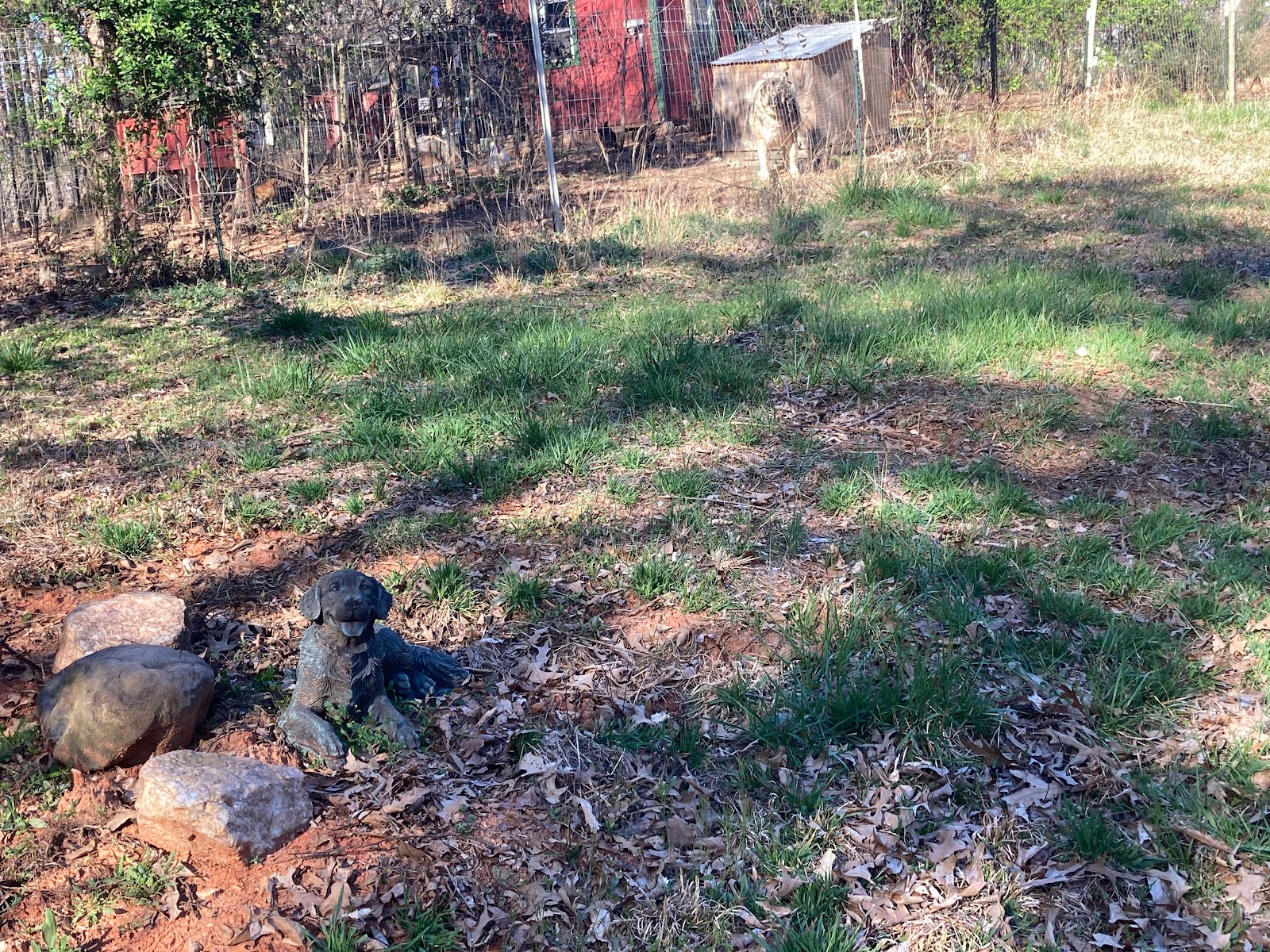
The other day, 3 years ahead of schedule, I notified my employer that I'd be ending full-time work for the university at the end of the year. I'd just harrowed the hillside below the spot shown above; we'd buried our first livestock guardian dog, our beloved Vela, at the top of the hill. Life is short. In 2017, Vela had been with us 2 years and was in her vigorous middle years. Now, she's resting.

Big decisions when to retire are naturally fraught with emotion, but honestly, it was the happiest decision I've made in a long time. I don't hate my job or colleagues, but unlike many of them, I have a Plan B waiting. It differs from many retirement plans I hear such as "I'll travel more" (great!) or "I'll be more active in my church or community" (fine!).

I'm neither religious nor able to travel as much as other academics do. Luckily, I find my joy in work with words, machinery, and plants. For so many years, I realized that I love the solitude and hands-on experience of writing, gardening, forestry, and tending to land. I'm happiest on a tractor for many hours on end, coming in the house to share lunch with my wife and discuss what we've been doing that morning. My favorite pastime involves fixing and maintaining machinery and equipment; I find it much more rewarding than dealing with the messy intricacies of classroom or office. I'm getting more social, because it's healthy, but generally, others wear me out. 

As my late father-in-law put it, when done with a task "I like something I can put my hands on."

In Portland we discussed how a mere hobby would not be enough to fill the hours that require intellectual company. My farm-work is not a hobby in the same way as, say building models or restoring an old car, but I got the message. I took it so to heart that after the conference, I began a book project that saw publication in 2019. Nowadays, my plans are less grandiose, but I plan on more fishing and hunting. Those hobbies are great fun but don't quite fill the bill for a healthy retirement.

Having given lots of thought to this transition since 2017,  I'd advise any of you thinking of joining me in the long twilight of a working life to take stock of what brings you joy physically, emotionally, and intellectually, especially as your physical abilities will begin to taper off. A guy named Mr. John Deere helps with that, to a degree, as I find it hard to hire day labor, even for $20/hour in cash plus gas money and lunch. But no pay will buy me intellectual debate over a lunch table.

For that reason, I plan to teach part-time in retirement in my university's Master's Program for continuing students. Most of the work will be full-remote for small classes, allowing more time to help my students develop intellectually. Given my research and writing interests, I plan to be on campus weekly and that will include lunch with old colleagues, attending arts events and seminars, even going to a professional conference every few years in areas where I'm still writing professionally.

All that without the messy things: committee assignments, office hours for undergrads, lots and lots of grading.  That means more solitary time on the tractor or behind a chainsaw or at a work bench. I've lots of ideas about managing invasive species, cultivating land for pollinators and native wildlife, and more.

You'll read about them here.


Monday, February 5, 2024

Slow and Fiddly Hobbies, 2024

Andy and Lance, Detectorists

Back in 2017, I reported on my passion for "fiddly" and slow hobbies: mostly the solitary pursuits of building models, fishing, gardening, reloading my own ammo. It was a time of political disaster then, with a megalomaniac careening us unchecked toward a dark future, packing the courts so things he ruined could not easily be undone. It could happen again. I could have fled the country or gone mad, but instead I continued to find solace in slow hobbies and not living by the dopamine fixes and doom-scrolling provided by addictive smart phones. I grew up regarding golf as a hobby for old white rich people, but really, it would be a fine sport for me if it were more sustainable, environmentally.

Not long before that dark time of American dysfunction, a tremendously interesting series ran three seasons (in British parlance three series) on BBC Four, Detectorists. We don't watch TV beyond an hour weekly, but this one was so great that after streaming the first episode, we decided to buy the DVD. It's good enough to own, and hard enough to find to never, ever lend to others who might not return it.

We joke with others that we love "cottage porn," British TV that commemorates a simple rural life free of the hateful political stickers on clownishly lifted pickup-trucks now haunting America's countryside. Think of how twee All Creatures Great and Small is, as comforting as a mince pie. Detectorists, on the other hand, not only rejects escapism but moves its story to the present while adopting a wistful, resigned tone. The duo behind the detectors, Andy and Lance, are looking not just for metallic treasures under farmers' fields but for meaning. The show has a surprisingly existential bent, though not a lugubrious one. By adding gentle moments of humo(u)r, creator Mackenzie Crook manages the nigh-impossible; the characters' failures and modest successes remind me of the balance struck in the two excellent original Charlie Brown animated specials. Consider Linus' angst in the pumpkin patch, when the Great Pumpkin never arrives, or Charlie's moment of doubt and pain over an already-dead cut tree when he cries out, "I killed it."

Like the Peanuts characters, those in Detectorists do find solace, unlike Beckett characters or most of the Beat writers. Yet their regrets remain. That makes the show's comedy unique. One message? Bear adversity with a wry, even sardonic, sense of humor. Aside from a running gag about Simon and Garfunkel, the humor is sidelong. One sees the "Finds Table" with a carefully lettered but amateur sign at a meeting of the comically under-attended Danebury Metal Detecting Club, it's such an instance: pull tabs from beer cans, pence coins, old buttons and shell casings. Yet, sometimes, gold. It's still out there.

Danebury Metal Decectors Club T Shirt

Rural life for more than 11 (!) years has taught me that thus philosophy works. I employ it when others tell me of their favorite "must see TV." Usually it's too silly for our cultural moment or so violent that it provides not even a slight respite from the news. Yet the philosophy of Detectorists, ultimately aligned with classical Stoicism, might work broadly beyond rural America, as we lose and find things in years ahead.

It's fine if you watch an episode and find it too slow, as some reviewers did when it ran. Slow is my favorite speed now.

I have yet to buy a metal detector, though we have talked about getting a pair of entry-level models to look for things on our property in Buckingham County. 

At least I will buy the DMMC T-shirt.

Monday, August 21, 2017

Why I Like "Fiddly" Hobbies


My last post about canning discussed my desire for hobbies that focus the mind completely. They also produce something I can use or enjoy in some way. One reason you will not find me staring at the smart phone all that much or watching TV comes from my belief that when I'm done, I can, in the words of my late father-in-law, "have something I can put my hands on." A friend called such hobbies "fierce" but I prefer "fiddly" because they involve a lot of geeky knowledge combined with special tools and learned craft.

I suppose writing has all that going for it. For many of us, hobbies enrich our knowledge while keeping at bay what writer Joseph Conrad called "that obscure feeling that life is but a waste of days."  Hobbies can immerse us in social circles online and in person.

There's also something more at work with fiddly hobbies. Consider the urge refinish furniture, make one's own clothing or knitwear, spin wool, restore old cars, fly fish, and renovate historic houses. All these tasks immerse ourselves not only (when needed) in the virtual but in what I call, with a twist on Baudrillard's term, "The Garden of the Real." Gardening, too, can be a fiddly hobby, when practiced a certain way.

Yet fiddly hobbies are different from other pastimes I enjoy, such as travel done well and off the tourist track.  My travels change me and leave me with memories and some mementos. Fiddly hobbies are like a good holiday from the day-to-day that never ends.

Since the 1960s, I've built scale models. In fact, my earliest modeling memory is of spray-painting my eyeball in 1968, during the Richmond riots following the death of Martin Luther King Jr. As glass broke from looters a block from our house, my mom, without a car, had to phone the hospital to get advice on how to rinse out my eye.  Yet I most recall how good the Jaguar E-Type looked to me in a decidedly non-stock shade of metallic Lilac.

I still build a kit or two every year. My current project honors a deceased friend, Gary Braswell, an avid collector of realistic action figures. He had in his stash a nice American Volunteer Group "Flying Tiger" pilot standing about 12 inches tall as well as, in the same scale, a Zero-Fighter pilot from Pearl Harbor. I decided to pose each pilot with a scale model of his sort of plane.

Getting the kits together involves a lot more detail than my long-lost Jaguar and, for that matter, a lot more safety. Today I use airbrushes, different types of glues, specialized tools, and I take months on a kit. I do a lot of research on aspects of correct paints and the weathering on particular subjects, going so far to mix my own shades of paint for certain projects.

Reloading is my newest fiddly hobby, and I bring to it the same level of research that I employ with models, but even more care. I picture a few reloading tools here, for .38 Special and .45 ACP rounds I shoot for target practice. I have a case trimmer, different measures and a "trickler" for gunpowder, a Swiss-made caliper good to thousandths of an inch. There's a fat Lyman manual with precise information, because a mistake, such as overcharging a bullet with powder, could mean a trip to the hospital or the Great Beyond.

Reloading led me to an epiphany about American gun culture that has almost nothing to do with firearms.

Long ago, most of us could work on our cars, if we wanted. Today, even an oil change is difficult without a lift or special tools. To a large degree, our cars have become a collection of computers on four wheels. Meanwhile, what seemed a safe refuge for tinkerers has vanished. Just a short decade and a half ago, I built both PC and Mac desktops from old parts, and I donated them to needy families and local charities. Now, in the age of SSD drives, flat-screen displays, and wafer-thin laptop cases, there's not a lot inside a CPU that a user can service.

I cannot even imagine working on a smart phone.

Modern gun owners, compared to the old guys who went out to hunt with a bolt-action rifle and kept a simple revolver in the night stand, trick out their firearms with optics, special triggers, new grips, and all sorts of internal and external upgrades. It amazes me how geeky the gun forums become with tales of amateur gun-smithing, barrel swaps, and changes to recoil springs.

Whatever the political and moral questions that swirl around America's fetish for guns, there's this fiddly-hobby, hot-rodder aspect that most critics and enthusiasts of firearms tend to ignore.  Of course, for some of the gun hobbyists I meet, I'd feel safer if they decided to build a few model planes.

Whatever  the hobby, the need to tinker exists on both sides of the Atlantic; in the UK I've been shown many DIY projects and the products of fiddly hobbies. There is something delightful about the hours slipping by, slow enough to savor their passing, as one engages in a fiddly hobby.  I might, if I can find one still on radio, have a baseball game in the background.

You just won't catch me in front of a TV watching hours of baseball or other sports. Now playing baseball, that most fiddly of sports? Perhaps in my next life.

Meanwhile, I have my 2017 fishing license and that involves infinite fiddling with lures, leaders, sinkers, respooling old reels, and stocking the cooler. I'm a fierce fisherman, too. I don't tend to go fishing to drink beer. It's about catching fish, finding the deep spots where they linger, scouting a bank for just the right overhanging tree to cast under (but sometimes into). Soon I'll have a lifetime fishing and hunting license from the State of Virginia, so I can continue my fiddly hobbies until I'm too old to clamber into a boat or get up a tree into a deer stand.


Buying a Vintage Tractor for Farming? Features & Safety

    Author's note: this piece ran in edited form and under a different title at Hemmings Daily. I post it here in original form to shar...