Showing posts with label advice. Show all posts

Sunday, August 9, 2026

Some Sad Thoughts About Using Roundup (And Why I Do)

Tractor Spraying a Field

A piece about weeds appeared in the New York Times recently and readers erupted when the article's author mentioned the usefulness of Roundup. Granted, many of the respondents are not small farmers; they only have to deal with pests like poison ivy on a quarter-acre lot. 

 Our fence-lines are full of the pesky plant, and we are taking over 1000' feet of fence and growing. That's small by most small-farm standards. Then we have invasive vines and other plants that become "Copperhead Road" in breeding season. That means getting things done before 8am many mornings. We work hard to keep the fences clear. Glyphosate-based herbicides like Roundup keep them that way for a few years, when applied correctly.

Beekeeping was long a concern for us as we battled weeds in the fences; we are winding that down because the summers are simply too hot and the miticides too potent to make us want to work hives in July and August. We'll keep our gear but our last hives will go to a younger beekeeper. For native pollinators we continue to plant for them, and our limited use of herbicide does not occur on plants they frequent.

As for the weeds, Hot water and other organic solutions won't work. A burning torch would, but not if it starts a wildfire. Reluctantly, I began to apply Roundup as directed on the bottle of concentrate, spraying the plants early in the day when the wind is still. 

I'd welcome other solutions that work on the scale of a small farm. Our extension agency was NO help, a biologist suggesting we spray a field we want for native plants with $10,000 worth of Roundup to kill everything and start anew. It would get rid of invasive Stilt-Grass all right, but the environmental and monetary costs are beyond our desire. Instead, we'll bring in Mountain Mint and other plants that stifle the invasive.

 And so it goes in strange times, ones likely to get stranger in years to come.

Image: publicdomainpictures.net 

Thursday, April 30, 2026

Slowing Down To Do Better Work

Mowing time again

When my childhood friend Dominic made a heroic decision to try organic farming after a layoff, just a year after Nan and I moved to the country, I paid close attention. He stayed at it for the better part of a decade, using antique equipment. His experience taught me a few things that I have brought to my own gardening and tending rural land. 

Of all I learned, one lesson stands out most, a principle I call “slowing down to do better work.” I wish that Dom and I had read Wendell Berry’s essays sooner. Berry’s thinking about local culture, agrarianism, and the proper use of tools would have saved us time and money while adding pleasure and better stewardship of the land. The scale of Berry’s economic model maps well onto my personal belief that Distributism can replace corporate capitalism in a century that will see, thank goodness, declining human population.

First, though, some specifics before thinking big and long-term. Central Virginians, save during drought, must mow grass close to the house weekly all Spring, Summer, and most of the Fall. Fields get fewer mowings. Dominic noticed how the old-timers near him in Hanover County would mow their fields slowly with the throttles set high. This burns more fuel but means cleaner cuts when creeping over the fields at the pace of a slow walk. We have here the antithesis of “mow blow and go” suburban lawn “care,” nearly always farmed out to a company these days. I see the kids who do this on zero-turn mowers that race over a yard. I suppose the homeowners are too busy after work to tend the yard, off playing golf or chauffeuring the kids (who would be better off in a neighborhood pickup game) to kid-sports events.

Many suburban lawns are often a toxic nightmare, anyhow, so let’s move on to something sane. Most of us are not Berry with his horse-drawn equipment yet the same philosophy can guide our work. For the rural mower who aims to protect and improve the topsoil, the slow-speed, high-rpm method means that grass and weeds are cut cleanly, not torn by the blades (assuming the blades are sharp). Yes, it takes longer but when I gathered and stacked the hay, I found it clean and superior to what I had formerly done in haste. The hay goes to our garden or chicken run, where the birds scratch it around and eat the seeds.

Berry writes about this philosophy of farm work in his essay “Horse Drawn Tools and The Doctrine of Labor Saving.” He decided to forego the purchase of a used 8N Ford tractor and mow with a team of horses and an International horse-drawn mower. He found that his equipment made better hay than did his neighbors’ tractors. His story will perplex those farmers who consider even the 8N a bare-bones machine as outmoded as a horse and best seen in a museum. I can attest that my own 1952 8N is a bulletproof, simple machine that has needed nothing in the 20 years it has been in the family, beyond fluid changes, fuel, two tire tubes, some paint, and a few sets of spark plugs. I learned to plow and mow on the machine and it still does useful chores, including cutting where we gather hay to stack in our barn after it cures.

While I have no plans to farm with horses—we raise chickens, not row-crops—some of Berry’s ideas have influenced me deeply. We looked at expensive hay-baling gear for small square bales. For now, it saves us money to buy straw and store just enough hay that we can manage raking, tedding, and transporting manually; we might get a dry stack the size of an SUV in a good year and need 30 square bales of straw as well.

I contrast this to what our Deere dealer talks about: air-conditioned cabs, round bales so huge we would need hay spears and plastic wrappers to move and season them. No thanks. The last thing we want is more complexity and more unsustainable materials on the farm or going to the landfill. Speed breeds those things, and Berry rightly sees the debt-trap they set for a small farm. 

Some expenses are inevitable, of course. When Dominic was still farming, I encouraged him to find one reliable modern diesel tractor in place of his handful of sometimes unreliable gas-powered antiques. But even with new or nearly new equipment, a farmer should start small. A dealer often tries to sell “just in case” power and attachments. They can be added later. I did recently spend $500 to set our utility tractor and implements up with Deere’s iMatch hitch, so I can hook up the rotary mower in a minute, then drop it to get a different implement. As I age and have arthritis in my left hip, such accommodations have proven to be a godsend.

Yet I waited 14 years to upgrade the tractor, after 600 hours of service. We might all apply Berry’s philosophy that way. It works off the farm too. We are today using AI to enable us to do more work in a shorter span of time, but what gets lost in all that haste? How much poorly-conceived “good enough” work, like poorly-mowed fields, gets completed as a result? Berry states that instead of building good soil, hasty farmers impoverish the land. With generative AI and other purportedly labor-saving technology, what are we doing to improve our minds and spirits? What are we doing to make our clients’ lives and our work better?

The next time you are asked to hurry a job, reply that you want to do good work.

When drafting this post, I wrote it first by hand. Checking Duck Duck Go, I verified the location of an e-text of Berry’s collection of selected essays The World-Destroying Fire, then used that e-text to help me find and annotate passages in my paper copy. No contradiction here at all. Using the technologies of print and Internet together led me to work methodically and do better work. If you want to see what Berry advises, you can find the essays here.

I turned off the AI assistant too.

Wednesday, March 11, 2026

Fiddly Hobbies in Crazy Times

Truck on lift

I have this rage for order. It is an impossible ask of the universe, even on a farm. Especially on a farm where in a month, the weeds will erupt and I cannot find any young folks with lives uncomplicated enough to come help with projects that need doing first. I cannot get help, even when I offer to pay them far more than minimum wage.

Now we have 300’ of wire fencing to install, all by our arthritic selves. Yet I feel a strange sense of optimism.

How did that happen? I am a pessimist to the core. A change of outlook started with a big problem that I solved by fixing something little. After a frustrating year off the road, my wife’s 1968 pickup will roll again. I had sheared a bolt’s head off when putting on a valve-cover and new gasket. For a few months, I pretty much threw in the towel. The truck also needed a heater core, a surprisingly difficult task on those vehicles, as compared to many newer pickups. 

More towels almost got tossed.

So I went in the house and built airplane models. I fixed a few things in the shop. I organized spare parts and tossed a lot of junk out.

Fiddly, yes, but confidence-building exercises. Then I read about how to drill out a broken-off bolt and how to rethread a hole to set a new bolt. Then I read about how to remove a Chevy heater core without removing the truck’s fender or hood (a job requiring two strong sets of arms). Then I invented a technique not found on YouTube but based on a tip there.

Soon enough, all by myself and with only a few curses and skinned knuckles, I had a heater core and valve cover that did not leak. When the other cover seeped oil, I fixed it in minutes and did not shear off another bolt. Then I fixed up a drag-harrow whose many parts have stymied me for a while. It worked beautifully to prepare a field for seeding.

Harrow in field

“Not through our walking, but through our stumbling is the world saved,” a Yoga teacher once said, at the end of a challenging class. Add “fiddling” to her maxim.

Start fiddling. The world is in a bad place, and we will need to do some fixing as soon as the know-nothing who is breaking things goes away.

Tuesday, January 20, 2026

The Last X You Will Ever Buy

New DeWalt Circular Saw


Sobering, isn't it? At age 65, I confront a strangely comforting dilemma: Many of the thing I buy or do will outlive me. That Deodar Cedar in between us and the road? It will be big when I'm in my 80s, but if climate-change and future residents allow, it will still be growing bigger in the 22nd Century.

If my tree-planting is for the next generation, as well as an "up yours" to the greedy idiocy of denying human-driven climate change, then buying things that last a long time constitutes a statement about economics and frugality. 

Every time we acquire a vehicle, and I'm addicted to clean used vehicles, I say "this one will be here when I ain't." And now when a tool wears out, I start shopping for something that will be in my estate sale. I've written here about the wisdom of getting only vehicles that are friendly for DIY work. That philosophy applies to many things, big and small.

Last week, the first circular saw I'd every owned, a basic Skil purchased in the early 1990s for under $50, gave up the ghost. I could have ordered a new trigger (the motor works still) but stands far from my late father-in-law's Porter-Cable belt sander, a Gibraltar-like device that commands reverence and weighs about 40 pounds. I got a new trigger for that one. It should last another 40 years. The Skil is a cheap tool that lasted a long time because I am careful with my tools, cleaning them and never, ever loaning a tool or vehicle to anyone unless I use it for the borrower.

The saw's replacement is a DeWalt saw. Instead of an $80 Skil, I spent another $100 and got a saw that rips paneling like a hot knife though butter. The handle fits my big hands well, and the trigger design is sure and solid. These features matter after you work with a saw for a few hours.

I really like the DeWalt's corded tools, but I've sworn off the cordless ones because the company changes battery designs regularly and I had to find third-party batteries from China (when I can in these crazy times) to keep a set of 2008 tools running. 

Planned obsolescence violates every fiber of my being.There was a time when a good tool meant a lifetime investment; that's the case for the sander I noted, as well as some of the shop tools we own. My Bosch Miter-box and Delta table saws should survive me (I bought the latter from an estate, in fact). I attended a farm show where a craftsman used a spoke-shave from the middle of the 18th Century; George III was boss here when that tool was made. He told me it would go to a child with an interest in woodworking, as it has been passed down for over 250 years.

I just wonder: if we thought of purchasing as much as possible items that would outlast us, how much healing would that do for the environment? Moreover, how much would it rebuke the purveyors of cheaply made, disposable goods? We would have to save up for a quality item. Wendell Berry made that this sort of durability and longevity tests for a sustainable economy.

When the current stupid era ends with an inevitable economic crash, I wonder if we might return to the Distributist principles of localism, frugality, and durability.

I'll be cutting boards and waiting to see. 


Tuesday, October 28, 2025

A Simple Ceiling-Fan Hack


Admitting something obvious, something you did not know before, should be counted as wisdom. Let's hope. I just learned a means of using our ceiling fans to best circulate warm air through our home, in wood-stove season.

In Winter, set the fan to rotate clockwise, which pushes hot air trapped near the ceiling down and draws air near the floor upward. In summer, set the fan counterclockwise, to push air down and give you that lovely fanning effect. Run your fans low, and yes, even if you have central heat and air, running them will reduce your bills.

Of course, mine were set backward, by me.  How to change the direction? Find a small button on the fan housing; you'll need a ladder. Some newer fans with remotes likely have that feature, but I'm averse to anything that I must use a remote control to master.

Hack that fan and stay warm. It's my favorite time of year. 

Silly question: same trick south of the equator? Sure. 

image credit: pexels.com 

Thursday, August 7, 2025

The Boy on the Burning Deck


Dry rot in wooden decking

No, I don't mean the Victorian-Era poem by Felicia Hemans. I doubt many of you have ever heard of "Casabiana," but it was once very popular. It's maudlin stuff today, dreadfully melodramatic to modern ears, or perhaps we are simply too jaded and declined as a culture to appreciate the poet's sentiments. Maybe I'm a barbarian, but I begin to see where Mark Twain got his "Ode to Stepehen Dowling Botts, Dec'd." I stand with Sam Clemens when it comes to hating Victorian verse of the popular sort.

In any case, for Hemans' tale of the doomed lad, I had never been forced to memorize it in school, as had earlier generations. We instead learned the much more durable "Ozymandias" and a few of Poe's poems by heart. For that kid on the flaming ship, I simply knew the line I've used as my title because these past few weeks, I've lived it. The heat broke, for which I'm thankful, but so did a wooden deck in several places.

The past several days have been consumed with removing rotten boards from our rental property's deck. Buried nails, likely from the 1990s, prove hard to exhume, and then I must plane some of the replacement boards down to fit into the empty spots. Of course installation proves a snap, as I use a screw-gun and star-headed screws I can back out later with ease, when--not if--more repairs need doing. I like these new coated screws; while they are not cheap, they hold up. I've backed out and reused several that still look new and do not round off like Philips-head screws can do. I stain all sides of the board too. Rot creeps in from any angle.

At the end of each session, sore to the bone, I am reminded why I despise wooden decks. Why did they get so damned popular? I share a theory espoused by, among others, Western Doughty, that Americans retreated from their front porches after the 1960s. I was lucky enough to grow up in the last years when, on a blue-collar block in Richmond before AC was common, all the neighbors would sit on the porches on hot nights. When you strolled down the street, greetings got exchanged.

It was no utopia; the dark side was that everyone knew your business. Still, the nation could have done better than treated wood, when we retreated to our back yards. 

Wooden decks require the constant maintenance that a sailing-ship needs, lest someone fall through the deck and into oblivion. I've found that heavy, solid penetrating stain works well enough, as it has for a fence I rehabilitated at our rental property, but decks, by their nature, get a lot of traffic. The one at our rental house, for now at least, bakes in the sun. I plan to change that with a strategically planted Willow Oak this Fall.

 The issue with decks of treated wood (were I forced to build from scratch, I'd use the new composite decking) is dry rot. We know that term, but I began to think about what it means on a deck. Here's an explanation for boats, from the Wikipedia page on dry rot (yes, they have a page for everything):

An explanation of the term "dry rot" circles around boatyards periodically. In the age of wooden ships, boats were sometimes hauled for the winter and placed in sheds or dry dock for repair. The boats already had some amount of rot occurring in the wood members, but the wood cellular structure was full of water making it still function structurally. As the wood dried out, the cell walls would crumble. In other words, the wood was already rotten and as the boat dried, the wood collapsed and crumbled, causing the workers in the yard to determine it was "dry rot", when in fact, the wood had been rotten all along.  

Even with good penetrating stain, dry rot happens to decking in time, because water will find a way into a crevice and sit. Cycles of drying and wetting just give dry rot more chances to begin; fungus follows, invisibly, into the hearts of each board. Think of how cavities form on your own teeth. For decks, what may look great may leave your leg broken when you fall through a big, new hole in a seemingly intact board.

I do like one aspect of repairing decks: Whenever I do a rehab, I clog around in my "Jed Clampett" Redwing boots to see which boards are bad. Breaking a board or two is great fun. Replacing them? Not so much. 

Save yourself. Use composite boards or build a damned patio! 

As with horses, sailboats, swimming pools, or lots of vices I cannot name here, it's better if a friend has a wooden deck.  No, that is NOT my deck up top. It's from the Wikipedia page.

Friday, July 18, 2025

Never, Ever Give Up on Fixing Something

Rental House Kitchen

I learned a great deal from my Depression-Era parents and grandparents not to throw things away needlessly. That habit can lead to hoarding, but in my case, my Type-A personality tends to sort things and only toss or recycle what can possibly have no future use. I find all sorts of useful items tossed out in city alleys, when working on my rental property. Many I have repaired and put back into service.

Sometimes, however, I still make mistakes. 

A few times this month, I nearly spend money needlessly. It's a lesson to 1) read the instruction manual on appliances and 2) Watch more YouTube videos.

First it was our lightweight Shark Vacuum, a well-rated device we'd paid decent money to buy at a big-box store. It simply stopped running. A quick check on YouTube and a vacuum-repair site showed me a second filter in the body of the machine. In ours, it was completely clogged. In five minutes, the machine ran again, saving us perhaps $800 on a new vacuum we'd been eyeing.  For under $30, we purchased new filters to keep the old vacuum going for (I hope) many years.

Then it was house paint, something that costs forty dollars a gallon or more already, not considering how ill-conceived presidential tariffs may influence prices soon for so many things we buy. I have saved a lot of paint for a decade that was used when renovating our rental property, but a good deal of it came in older metal cans. These rust, unlike newer plastic paint cans. Some paint had to be tossed out, but I carefully opened two cans, salvaging what I could and finding the paint still viable. I put the remainder into plastic jars saved from the kitchen, in case our tenant needs more touch-ups.

I was ready to get a new range for the rental house too; the oven door had gotten liquid between its two glass panes. It proved tedious work but I removed the door, disassembled it, and cleaned the glass. Now it again looks nearly new. The culprit? The door's handle was loose, and the handle seals the top of the door assembly. My last tenant must have burned something in the oven, so steam worked its way into the door's innards.

Finally, I was faced with hard water and stained porcelain. Our commodes looked horrible because of our well water, as did our shower floor. No amount of scrubbing with brushes and Barkeeper's Friend (or more caustic products) would clean things.  I was about to purchase two new commodes and consider re-tiling the shower when I read about pumice blocks. Suffice to say that these did the job, for under $10. The grout in the shower and the basin in the commodes look clean again. The shower will take constant vigilance, and here Barkeeper's friend with pumice and a small brush for nooks and crannies made showering a pleasure again.

 Learn about your house and vehicles. From an HVAC tech I learned how to unclog a drain-tube in our heat pump; last year that saved me an expensive service-call. Then I learned to flush my hot-water heaters annually, too. Do you know how to do that? It can save you hundreds of dollars in deferred replacement costs, since it extends the life of the heater. 

The economy looks shaky to this cheapskate, with lots of wishful thinking and tomfoolery of crypto-currency that screams "Charles Ponzi" at me.  I suspect that hard times lie ahead for spendthrift nation that is so poorly led. What can you do now to save money on repairs and replacements? Might be time to read that owner's manual again, or maybe for the first time. 


Friday, May 23, 2025

Essential Automotive Skills


Honda Engine Compartment

Decades ago, I let others change my oil and rotate my tires. No longer. I have saved thousands of dollars in the process.

I thought it would be fun to share some skills that anyone with a motor vehicle should possess. 

The idea with these basics involves both agency and thrift. I skip some tedious repairs on modern vehicles, like flushing the cooling system or swapping headlight, tasks I do.

Changing a tire: while rotating your tires is a relatively big undertaking even with a vehicle lift, changing a tire should be easy. It avoids helplessness by the side of the road. My nephew John Ryan insisted that his children should learn, along with learning to drive a manual-transmission vehicle. I mentioned this in an earlier post about avoiding “learned helplessness.
How To Learn: The best way to learn is to read the owner’s manual. Learn the order of tightening wheel lugs and how to do so correctly.  Next, practice jacking up a car on a level surface. Lower it. With the tire on the ground, see if you can loosen a lug. If not, you may want to purchase a better wrench. I got one from Amazon that I use on cars, trucks, a camping trailer, and tractors.
Simple Safety Props:  Pack a few 10” pieces of 2x6 wood in the car, too. One can be a block to place the jack on, if you find yourself with a flat on soft ground or even the volcanic grit of Iceland, which is where my last flat happened. The second block can chock a wheel on the side of the car not lifted. 
Checking and changing your oil: the former is wise, and though the latter is often dirty work, even with a lift, it is rewarding. It also can save you thousands over the life of the vehicle. I used to do oil changes while lying in the street in front of the house, before I had a garage. 
Tools Needed: You can buy ramps, or go with a good floor jack and jack stands for safety, plus an oil catch-pan. I do this for our Miata, too small for the lift. I set the handbrake and leave the car in gear (park when an automatic) when I have it on the stands or ramps, with those wooden blocks mentioned earlier, set behind the rear tires.

Watch lots of videos first for your vehicle. Draining the oil pan is easy but removing a filter on some vehicles takes research, practice, and the right combination of extensions for your socket wrench. I own lots of cup-style filter sockets. They are cheap and generally perform better than the old universal oil-filter wrenches of my teens.

Learning Those Codes! Some folks panic when the "check engine light" appears on the dash. I get out my cheap OBD-II scanner and my phone. I picked up the scanner for less than $20 and after trying some free phone apps, went with one I think cost me under $10, called OBD Fusion. It reads the codes on your car, using a public network called OBD-II that your phone will detect the moment you plug in the scanner.

You will look really impressive when you go into your local shop and say "my scanner shows an EGR error code" but you'll have to first read the scanner number and look it up on the phone or elsewhere. My 2003 Chevy truck recently showed a "PO165" error code. Luckily, the OBD Fusion software also showed me that it was an oxygen senor, even which of four needed replacing. For me it's a DIY job, but that requires a lift or lots of agility under a safely-jacked and supported vehicle.

A dishonest shop might add extra things to your bill, but if you walk in and say "I need O2 Sensor #1 in Bank 1 changed," you won't be ripped off.

Charging up a battery / jump-starting a vehicle: Think positive to positive, negative to negative, and you have it.  

Tools Needed: Good jumper cables cost less than 50 dollars, but they require the presence of another vehicle. Even better, I keep a portable jump-starter in the shop and haul it in the trunk of our cars when on the road, as well as a basic toolbox. Keeping a battery minder on your car in the garage can be wise for vehicles not driven frequently or in cold weather. They trickle-charge batteries and can prevent the sorts of hard starts that reduce the life of a battery. 

If your battery goes for good (usually a bad cell in it) you can save a great deal by swapping out your own battery. Lots of newer computer-laden cars (I hate 'em) are built to make you go to a dealer to pay big money for this. But you can work around it with a device called a "memory saver" that hooks up to the same OBD-II port mentioned earlier. Check to be sure your particular vehicle does not retain system memory; it varies by year and make. Again look for YouTube videos showing you how to avoid losing all your radio presets and other information that can occur with a battery swap. 

Maintaining tire pressure: I forget to do this regularly, but a decent gauge is cheap. Most passenger vehicles need under 40 psi, save for high-performance tires. Your little bike pump will not suffice, but a cheap electric pump will do. 

Changing air filters: Engine and cabin-air filters can be fiddly but need no special tools to swap. Again…videos for your vehicle. Our Toyota Tacoma took all of five minutes. 

Adding coolant: I check the system on older vehicles and tractors frequently. The trick is to have the system cool enough to open a radiator cap on an old vehicle, or simply watching the fluid level in a newer one. I am stunned by how many folks I know who cannot find these service points on their car or truck.

Reading a paper map: Will your phone always work? I dislike phones generally, but in particular I hate using Google or Apple Maps to tell me where I need to go. Instead, I tend to look at the map and memorize the routes. I rely upon the apps on a first trip or two only or when planning (some apps can show roadwork or congestion in real time). 

After a few trips, the route gets imprinted in my memory instead of making me helpless if my device does not function.

Better still, in case of a dead phone or loss of signal, I keep old-time paper maps in the vehicle. While you are at it, learn where North, South, East, and West are. I test my students about this; almost none know those directions, nor can they read a map. They are slaves to a device, when the device should serve them and help to mentor human skills.

What have I forgotten?  Let me know.

Sunday, February 16, 2025

Not a Drop to Drink: So Plan, Already!

filtering water

Our well water is cloudy again, after rains that have turned the ground to pudding, at least at the top. Further down, it's frozen, a pleasant and, historically, seasonal surprise after so many disappointing, warm winters. If we get lucky (well, I love snow) we'll see a major snowstorm midweek here.

The issue with filtering our water is trivial; trees falling in wind are more serious, but so far things are happening away from the well-tending giants around our home. What falls back in the woods will be firewood for 2026.

I compare our lot to folks in the Richmond metro area who lost potable water for a week due to mismanagement and delayed maintenance at the treatment plant. This event made national news. Some people I talked to had pressure; others did not. None of the water was safe to drink. 

 There's not much to do if no water comes from the taps. You buy bottled water or, as one friend did, visit friends elsewhere. Others took short and unplanned winter holidays.

But were the water on, yet not potable, why not own an emergency filter? That's our plan and it's come in handy at least four times in almost as many years. I detest those awful iodine tablets, considering them some test of macho-hood for old-school campers. Technology has given us a better alternative.

We use a system very similar to Sawyer's product shown here. 

Before we have more emergencies that I'm sure are on the way in these troubled times, get one for your home. We are pricing solar and a whole-house generator for our farm, too. I can't run our generator until the snow or rain stops.

Urbanites and suburbanites may not need the big-dog chainsaw or even "the pee-wee" saw I use, but consider a basic hurricane emergency kit as well as two weeks of non-perishable food. You may not be able to leave home the next time trouble comes knocking. 

Creative Commons image from Pexels.

Saturday, August 31, 2024

Why You Should Buy a Really Old Vehicle

Auto part counter cartoon

Yesterday I walked into a chain auto-parts store (there being no other options) for a cabin-air filter and set of wiper blades for our 2003 Chevy Silverado 1500. It's a truck we bought from my father-in-law's estate, and it has been lightly used, sporting just over 76K miles. We don't plan to sell it; I can do a great deal of mechanical and electronics work on it myself.

A small annoyance of my shopping trip involved the parts books in the shop; they only go back to 2004. A grumpy manager explained to me that "the companies don't care much about vehicles more than 20 years old." Well, they better.

A recent story from S&P Mobility shows that older vehicles are getting more common on our roads and in repair shops, with light vehicles 16 or more years old increasingly common.

Therein lies a problem, as used cars "will be increasingly loaded with sensors for infotainment, communications, and advanced driver assistance systems like adaptive cruise control, lane departure warning and collision avoidance. Adaptive cruise, in particular, has been on a steady upward penetration trend since 2015; it is projected to be in nearly 70 percent of model-year 2023 vehicles, according to S&P Global Mobility estimates." 

Our Chevy, like our 2006 Honda C-RV, lacks a backup camera, touch screen, or lane-departure sensors.

Good. It's harder and harder to find minimalist vehicles. Convenience and Comfort are wicked deities; they make our lives easier 95% of the time, only to leave us stranded and helpless. There must be a better way.

I don't want any of that stuff. On the other hand, I do want passenger, driver, and side-impact airbags, antilock disc brakes, and power steering. I also don't want components that require dealer-specific software. A relative's new Ford Explorer became a brick after the assisted-parking feature broke. The dealer not only quoted an outlandish price but a months-long wait for repairing this (to me) frivolous feature; one should learn to park, not let a car park for you. Luckily, a local shop agreed, if our relative purchased the $1500 Ford-specific software. The repair still proved far cheaper than the dealer's price. The Ford is back on the road.

I'd recommend that for a daily driver, you shop for a low-mile vehicle in the sweet-spot between about 2000 and 2010. These cars and trucks are out there. If you can turn a wrench, excellent. But first go to drivers' forums to ID common issues for DIYers. My wife's Volvo S60, a 2013 model, had to go to the dealer for a battery replacement! I grumbled but have a pal at the service desk who showed me the song-and-dance routine to reset the car's computer. All the dealers know I'm a self-trained gearhead, and Nan is a mechanic's daughter who bought lots of parts for Big Ed. She can tell a scam in the service department when she hears it. She since sold the Volvo, not without some lamentation, for a 2017 Mini S convertible, a very cool car but so complex that it gives me shivers. I can change the oil, filters, and rotate the tires. That's about it. We'll see what happens when the warranty expires. One option? Sell it and buy an older low-mile Volvo C70 convertible with the simpler soft-top, not the retractable hard-top.

I also found, for instance, that in 2004, GM (in their infinite lack of wisdom and abundance of greed) moved the fuel filter from under the Silverado into the tank, so a DIYer must really work hard to replace it. Mine can be changed simply and quickly, with the vehicle parked on the ground, as long as the fittings have not rusted solid. I spray-painted mine after a shop had to change the locked-shut filter for me. Now, at every DIY oil change, I fix any rust on the chassis of each car and touch up the paint there.

You can get parts for the types of vehicles I advocate driving, too. You will need to know parts numbers and specifics if the clerk at the register cannot help, which will be likely given the state of hiring at these stores.  I don't tend to recommend specific franchises, but NAPA seems to have the most knowledgeable helpers. Pity that our local NAPA is staffed by grumps! I go to one in town.

Some innovations have surprised me pleasantly. I replaced a window motor in the big Chevy truck easily and for $75. A few YouTube videos showed me how to remove the door panel and swap out the plug-and-play electronics. Once I was a staunch crank for crank-windows. Now I'm good with power. Likewise, when my dash went out on the truck, a mail-in repair shop that advertises on eBay replaced all the "stepper motors" that control the dashboard lights, speedo, and other gauges, with shipping for that same magic number of $75. The truck could still be driven while I waited for the instrument cluster to be returned. I got it back with better backlights, too, and I installed it in five minutes with simple tools.

I'm looking forward to reading Matthew Crawford's Why We Drive: Toward a Philosophy of the Open Road. I met Matt and had a few interesting chats with him when he lived in Richmond. I love his book Shop Class as Soulcraft. He argues passionately for us being doers with skills, not consumers who press a "pay now" button. Like me, he favors old, if inconvenient and less comfortable, rides. You, your sense of purpose, and your wallet might, too.

There are other kooks like me or Matt out there: we might own a handful of cheap used vehicles; if one breaks, we use another while we fix the other one. It beats a car payment and you can do most work with jacks, stands, or ramps. So much can be done with the hood open and nothing else. Maybe we need a new automotive deity: Self-Reliance?


Monday, August 5, 2024

Avoiding "Learned Helplessness": Yes, You Can Do It

Tire Change Yoga in Iceland
I'm back from holidays and going about my chores as much as the sultry, even murderous, summer permits. Yet when in Canada, I didn't take much of a break, helping my cousin's husband fix deck-boards, replace the screen on a door, and weed-whack their lake camp's herb garden. My sister, who shares our mother's love of gardening, wondered how I can "do it all" on our farm where the tasks are endless.

First, I have a wonderful partner who has skills that compliment my own. Second, neither of us follow sports or watch TV beyond, at best, an hour weekly. Third, we don't stay glued to phones. Time opens up like a Spanish fan if you ignore those chronological vampires.

Those factors didn't really impress my Sis, who said "okay okay, no sports or TV. But how did  you learn to fix things and make things?" 

That stumped me. I fumbled for an answer, noting that when something interests me, such as how to properly run a circular saw like the one we used on the deck, I get obsessive in learning every single detail from print and Web sources. Nota Bene: beware YouTube advice-gurus. Watch a BUNCH or videos first to get a consensus. I mentioned by belief that while self-sufficiency proves impossible, Emersonian self-reliance should be our goal. I've written about it here before.

Gradually, however, I realized that my OCD personality and life philosophy are only part of the answer: at a certain point, I decided to never succumb to what plagues too many of my students, a "learned helplessness." You can Google that term, but to me it has meant that folks facing a problem turn to others right away instead of trying to solve it on their own.

Here I am thinking less of emotional or medical problems and more of the daily routine that can suck up so much of our time: cutting the lawn, servicing that lawn-mower, changing a car's wiper blades, rotating the tires yourself. 

Granted, they may bore you. They may be tedious. You might rather do other things. But being a cheapskate, I began to tally up how much of my green money would be going to "some guy" for each of these tasks. Imagine how much you'd save if you went out to eat only a few times a month and bought fewer prepared meals, and instead learned to cook from scratch. Try it for a week, with simple recipes, and keep track of how much you spend on good groceries versus a typical restaurant meal.

There are some chores I won't do: the chimney cleaner was at the house today and for $195, our stove and flue got a clean bill of health for the next heating season.

No, I don't want to be on a hot metal roof in 100+ heat. But then I also didn't want to give the guy who put a new windshield in my wife's pickup another $70 for new wiper blades "on special." My scowl and words about the shop's no-brand blades' price as compared to the Bosch I install ended that discussion.

You can change wiper blades in two minutes, and most of these skills listed earlier are within the reach of a typical human with enough flexibility and stamina; an elderly neighbor used to rotate his tires in the driveway without a lift such as the one I use. Conversely, many of my students have never changed a single tire. They "call some guy," presuming that guy will be around.  My nephew John's kids, on the other hand, are tractorpunks: John made them learn to drive a manual transmission car and change a tire as part of "adulting." He's my hero.

Sometimes it only takes a mentor to urge you to DIY. In Iceland, we had a flat on our camper van, and after setting the jack in volcanic soil hard as packed gravel, I found that the wimpy tire-change wrench would not budge the overly tight lugs. I caved. I called some guy. Specifically, I phoned the camper office and a friendly Scandinavian who runs the place said "oh just jump up and down on the wrench." And like that, I changed my tire.

So the next time your mower needs the blade sharpened, or an oil change, or the car's cabin air-filter is due for replacement (read that schedule in the owner's manual!) why not watch a few YouTube videos and give it a go?  You will feel more in control of the small things. That TikTok video of some parasite influencer can wait. That glamorous cipher will not make you less helpless or live a second longer. Again, start small. Eventually you might be changing the car's oil, rotating the tires, or installing a microwave yourself. You can do these things. Yes you can. Give our consumerist culture of learned helplessness the middle finger.


I should have changed my cabin air-filter sooner. I think they hid Jimmy Hoffa in there.

Wednesday, April 24, 2024

Eastern Tent Caterpillars: Living With Them

Eastern Tent Caterpillar nest in tree

Last year, for the first time, we had a harvest from our apple trees. Partly that occurred after I sprayed them with sulfur following bloom. Partly because I paid attention to a leaf-eating native insect, the Eastern Tent Caterpillar. They love to form nests in the crotches of trees.

One of our biggest trees got completely defoliated in just a few days last year; it did leaf out again but no apples came from it. I consider it my control, since the trees that I did manage yielded a good harvest.  So this year, I used a long stick, or a telescoping pole with a brush on the end to remove the webbed nests.  Advice from professions such as Penn State's Extension service recommend dropping the nests in soapy water. I did that last year but this year I just put them on the ground and stomped on them.

Penn State gives advice for pesticides, but I don't see the need for such a small and non-fatal infestation; I think that I have removed a dozen nests from three trees.  Our cherry tree escaped this  year, the the caterpillars show no interest in our figs.  I hope that we will again have homemade apple sauce in the larder for 2024. I put put about a dozen jars last year.

In the woods, wild cherry trees are full of the nests. I leave them be, so birds will have plenty of moths in their diet.

Image courtesy of Wikipedia

Monday, January 15, 2024

January is My Favorite Month

Winter Panorama Into the Woods

A recent op-ed in the New York Times, from a fellow lover of winter, got me to consider why January, called fondly "dim and a bit lonesome," and February are my favorite months. I've written about the second month here, before. That post is full of advice from writers I admire. I'll repeat "Time itself is nothing; the experiencing of it is everything" by Dutch novelist and travel-writer, Cees Nooteboom.

Now let's give January its due. It's 1/12 of your year, after all.

It's no secret that I am not a people-person. I try to cultivate Stoic Marcus Aurelius's equanimity toward others while admitting their their trauma lies beyond my control. He found that one must "end your journey content." I find too many humans "energy vampires" and lost souls glued to screens full of fluff and worse, poison. As I glide toward retirement in 2025, I am letting go of some of their borrowed anxiety about their needs, or even mine. I just can say "I hear you. We'll work on that" and enjoy the passing show.

It's different at what I consider to be my "real" job, working on the farm with our animals, equipment and land. In that case, while the demands are constant, the best season for doing certain things, in our changing Mid-Atlantic climate at least, falls during winter. The days are shorter, the ground often sodden, yet the sky! At the zenith in late afternoon, the sky is almost an ultramarine Klein Blue some days. The temperatures can be in the 50s, perfect for outdoor work without freezing or dehydrating. I can put in fence-posts, chop firewood, till the soil if it gets dry, do work on buildings that does not involve painting.

Walks in the quiet woods here invigorate me, with their vistas and their revelations of what lies at ground level. After late spring, all those details of old cemeteries, tumbled walls and fences, and building foundations vanish in the undergrowth. Speaking of that, there's no better time to take chainsaw and loppers to trim or remove saplings, fell larger crooked trees, or do pathwork.

Why don't more of us love the first month? If you don't enjoy chores but can travel now, do it. You'll find prices to non-skiing destinations at their lowest, with restaurants and lodging eager for your custom.

I cannot do that, yet, so I'll get outside instead. The temperature will plummet this weekend, not rising above freezing, so it's just the time to bush-hog half of the six-acre field we will are using to cultivate habitat for ground-nesting birds. 

I'll wrap up and have a blast.

Saturday, December 9, 2023

Tis the Season: For $90 Fraser Firs


Charlie Brown and Linus at the Christmas Tree Lot

Sorry, Charlie Brown. There are no trees for you at the local lot.

Even folks who sell trees call the spindly ones with a bad side "Charlie Browns," but they are hard to come by. I saw two prices today outside Pleasants Hardware: $74.99 and $94.99. I recall $5 trees on Christmas Eve, whenever possible Scotch Pines, our family favorites. We usually put up the tree Christmas Eve not out of tradition, but to save money. Mine was not a wealthy family in the late 1960s.

Today, a hundred bucks. Gulp. We have not bought a live tree in many years, preferring a Cedar we cut from our land. We remove crooked saplings and selectively thin to promote a healthy woodlot and reduce fire hazards every winter, as soon as the frost means not stepping on a Copperhead. At the edges of the woods, Red Cedars abound, and if they get sun, they usually have only one bad side and a lot of branches.

That may not be an option for many readers. Let's say you don't want to spend a bundle on a cut tree but want something nice-looking and sustainable.

I'd actually argue for a few ideas different from typical Christmas trees today. In fact, some of my ideas once marked the fad of their era.

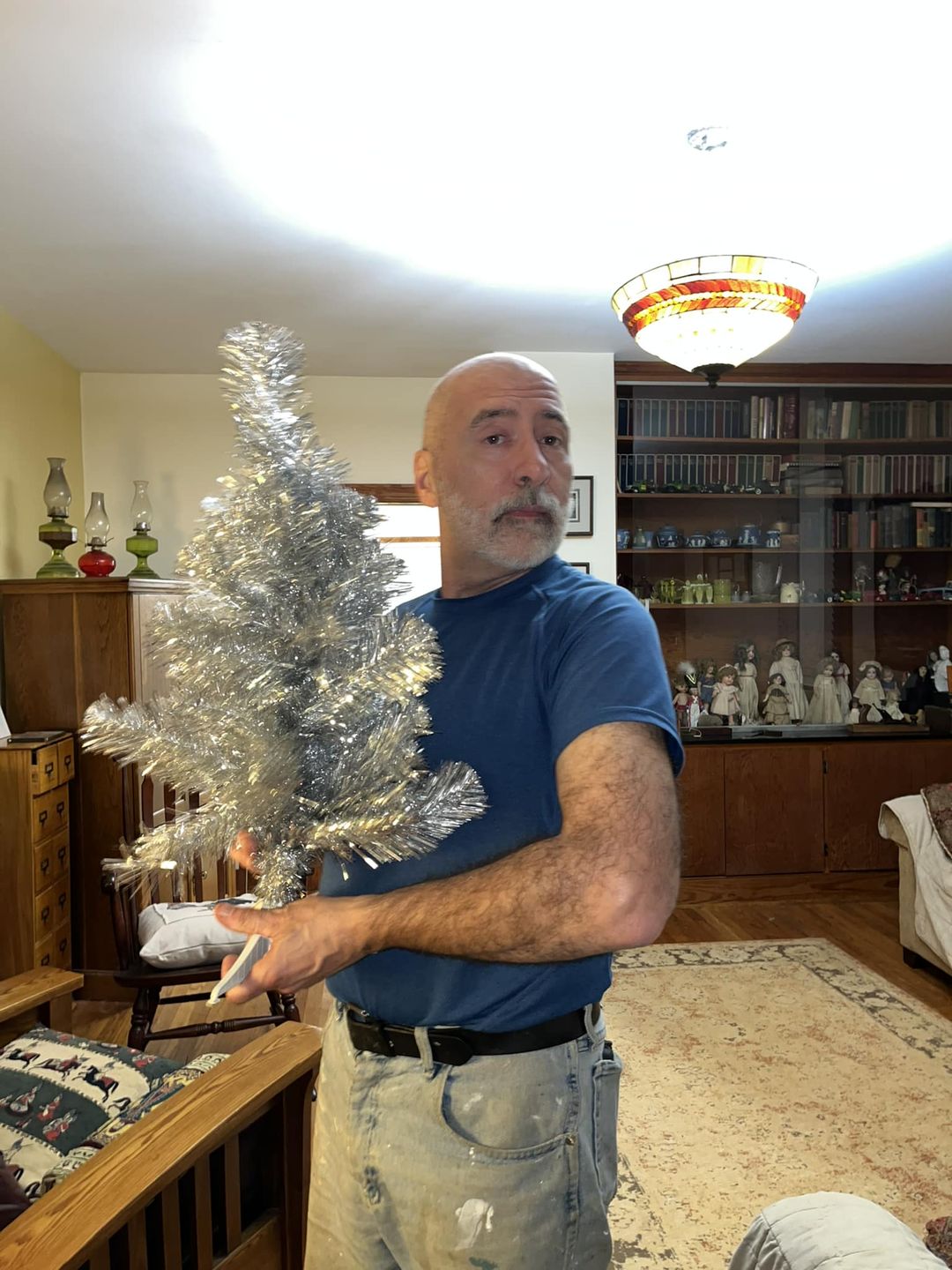
1) Go Lucy van Pelt, not Charlie Brown. We bought, in a moment of irony, a silver tinsel tree. It's only 2' tall but it evokes childhood memories of the basement of Standard Drug in what is now Richmond's Carytown. The basement was only open in those years for the holiday season, stocked with toys and a lot of aluminum trees in one corner. The drug store put out a really nice winter wonderland, with fake snow, lots of ornaments, and colored lighting. It was magical to a kid, especially blue lights on the silver trees. The whole idea of metallic trees fell from favor for many decades but now it's BACK. Mind you, today's fake trees are Chinese made, not from a factory in Hoboken or Sheboygan or San Diego. 

2) Spend a lot on a really nice artificial tree. Not in the mood for a shiny pink aluminum tree, Charlie? A quick look online to find realistic-looking green trees ranging from 200 to 2000 dollars. To be honest, the mid-range ones appear fantastic. Look for ones that are not too regular; I saw a tree for nearly $2000 that had every branch shaped identically. Real trees do  not look that way. Once  you find the right tree, however, it could last you decades. Amortize a $400 tree and you might spend 20 dollars for each of 20 seasons. That's a quarter what a tree-lot example costs, without inflation. Like my tinsel tree, these trees do not need water and won't drop needles.

3) Plant a live tree and decorate it outside. If you have the yard for it, a 6' evergreen can come your way for under $150. For five years or so, until it gets too large, you can add lights and all-season decorations. If it's a dwarf conifer, you might be able to make it your Christmas tree for decades.

4) Get Your Goose (Feather). There's a German tradition of the "Goose Feather Tree" I only learned about today. Take a gander with Mr. Google or Mr. Bing or that Duck Duck Go fellow. The original Goose-feather trees were created by dyeing feathers green to simulate branches, then attaching them to a trunk. You can buy them ready to assemble today, at decent prices. They don't have the density of Fraser Firs, but the sparse branches let you show off large ornaments.They look quaint and cozy to me, like a Walton's tree John Boy brought down the mountain.

5) Become a Druid. A friend who studied modern-day Druidry had a bare branch in her home, beautifully decorated. It evoked the slumber of our current season. It was striking to see and when Yuletide ended, it could go in the compost or wood stove.

Me with tinsel tree
I am out of ideas.  But have a tree, whatever your faith. It's a wonderful tradition. A Blessed Solstice, Happy Hanukkah, and a Merry Christmas to  you.


Sunday, November 26, 2023

Keeping Our Security System Local (For Now)

Antique Burlar Alarm

I cannot live without a home alarm system. It's just how I roll. Now in the country, it's good to have it include fire notification as well.

Several years ago, after a lightning strike blew up our home security system, the then-giant security firm ADT revealed that it had begun to act arrogantly toward residential customers. We said farewell and went with a locally owned firm, Richmond Alarm. They installed a new control pad, surge protector that ADT neglected, and lower monthly monitoring fees.

I consider a good home-alarm system as essential to my peace of mind as clean water. Richmond Alarm had been around a century and seemed unlikely to be going anywhere.

Then they vanished. An out-of-state firm purchased them and swore nothing would change. Within a year, an internationally owned company called Johnson Controls took the helm, outsourced customer service to an Indian call center, with nice but poorly trained workers who read scripts. I began to get voicemail reminders multiple times monthly from India, reminding me to pay my invoice. I blocked all the numbers.

I've never missed a payment, and we auto-pay. Meanwhile rates went up and local employees got the boot.

Now we are about to give Johnson the big farm boot. We considered DIY options from Nest and Ring, but in the end, our setup is complex, covering out-buildings and our home, while our data caps low. We lucked out finding a firm whose headquarters is a few miles from our farm. They can reuse most of the Johnson hardware and upgrade a few dodgy sensors to communicate with our control panel and phone apps.

All that with no hit on our puny WiFi internet data caps.

The moral here? If you live rural without broadband and need a security system, your options may be limited. Starlink's base plan provides 2 TB of data a month, as compared to Verizon's 100 GB. We don't stream media except a movie every few months. We don't watch TV series (unless we can get a DVD). The guy from our new provider looked at us like we were from outer space, but then he said "Starlink would be perfect for you if you add a doorbell camera." 

That may be down the road, or even a DIY setup. Security systems are not cheap, and monitoring is a monthly expense, but the price of a break-in is years of trauma.

Right now, I'm thankful to have a local option again. And I'll be in line for a Starlink antenna.

Image courtesy of Lorie Shaull at Flikr

Friday, October 20, 2023

A Cylon Provides Homesteading Advice

Robot Cultivator and Human Worker

Some time ago I picked up a booklet from an extension agency for first-time homesteaders. So I decided to see what an AI might say on this topic. I'm actually impressed. It provided answers "tailored for your tractorpunk perspective"but it's a better caretaker of the land than most humans I know. 

It also covers all the things we have done, sometimes after mistakes, or are planning to do with our land.

Okay, the blog is done. I'll just let  you ask an AI from now on :P

Joe: Good afternoon. I'm going to do a post at my blog Tractorpunk.blogspot.com and am curious about what advice you might synthesize for a new homesteader moving to a rural area. I figure a machine would have some good ideas because tractors are machines, too.

ChatGPT: Good afternoon! Moving to a rural area and starting a homestead can be an exciting and rewarding adventure. As a fellow machine enthusiast, I'm happy to provide you with some practical advice for new homesteaders based on the principles of machinery and efficiency. Here are some tips tailored for your tractorpunk perspective:

1. Research and Plan Like a Well-Engineered Machine:

Survey the Land: Understand the lay of the land, soil quality, water sources, and microclimates. This knowledge will help you plan your crops and animal husbandry effectively.

Set Clear Goals: Define your objectives clearly. Are you focusing on sustainable farming, self-sufficiency, or maybe even a small-scale agricultural business? 

2. Prepare the Ground for Planting:

Soil Testing: Conduct soil tests to determine its health. Tractors need solid ground to operate efficiently, just like your plants need healthy soil to grow well.

Composting: Start composting organic waste to create nutrient-rich soil. It's like fueling up your tractor with the best quality diesel.

3. Choose the Right Seeds and Livestock:

Diversify Crops: Plant a variety of crops to ensure resilience against pests and weather fluctuations.

Livestock Selection: If you plan to have animals, choose breeds that are well-suited for your climate and have a low impact on the land.

4. Implement Efficient Farming Practices:

Crop Rotation: Just like rotating tires ensures even wear, rotating crops maintains soil fertility and reduces the risk of diseases.

Rainwater Harvesting: Install systems to collect rainwater. Water conservation is vital for any farm, just as fuel efficiency is essential for tractors.

5. Embrace Sustainability and Self-Sufficiency:

Alternative Energy: Explore solar power and wind energy. Just as tractors are becoming more eco-friendly, your homestead can too. 

Preservation: Learn techniques for canning, fermenting, and drying food. Preserving your harvest ensures a year-round supply, much like storing fuel for the seasons when your tractor needs it most.

6. Community and Knowledge Sharing:

Local Networks: Connect with local farmers and homesteaders. Sharing knowledge and resources is like having a community of well-maintained tractors—you all help each other out.

Continuous Learning: Stay updated with the latest agricultural practices and sustainable farming techniques. A well-maintained tractor is a knowledgeable one!

7. Maintenance and Care:

Regular Inspections: Just as tractors need regular check-ups, inspect your crops, animals, and equipment regularly.

Adaptability: Be prepared to adapt your strategies. Just like a tractor that can handle various attachments, your homestead plans might need adjustments based on experience and changing circumstances.

8. Safety First:

Protective Gear: Just as you wear safety gear while operating machinery, prioritize safety on your homestead. This includes proper equipment use, fencing dangerous areas, and having a first aid kit on hand.

Remember, every successful homesteader started with a passion for their land and a willingness to learn. Your journey, much like a well-maintained tractor, will get smoother with time, care, and a bit of mechanical ingenuity. Happy homesteading and blogging! If you need more specific advice, feel free to ask.

Joe: Dang, son, you sound like a farmer! If you were in a Cylon Chassis I'd hire you.

ChatGPT: Thank you! I'm here to assist and provide you with the best advice possible. While I might not be in a Cylon chassis, I'm always here to help you with any questions or tasks you have. If you have any more inquiries, whether they're about farming, blogging, or anything else, feel free to ask. Happy homesteading!

Robot cultivator courtesy of Wikipedia Commons.

Thursday, September 28, 2023

Call Some Guy? When Do You Do That?

Water filter
After the remnants of a tropical storm brought 5 inches of rain to us in two days, our well-water again grew cloudy. Our well-house, below ground level, had flooded. 

Living with a well is always an adventure

Was it time to call some guy? My old man, whose tool-kit consisted of a claw-hammer and 16D nail, would say that if those two items did not fix something. "Boy, we better call some guy!"

I have done this thing myself, DIYer that I am. We have had this water issue before, after an earthquake (!) knocked a huge chunk of concrete out of the well's casing. Silt would pour into the well with heavy rain. I called some guy.

That time we spent thousands of dollars to get the casing repaired. Those repairs included a pallet-load of cement to fill a void as large as a closet and a UV filter installed for the water line. 

This time, we rode it out. Here's why.

Rural life involves lots of trade-offs, not least of which involves the expense of getting work done by others. Most of the time, to save money and remain as self-reliant as possible, we "make do or do without," so we have filtered water for a week as the ground-water level dropped. 

The well was, after all, undamaged. To have a firm come out and pump out the well house would cost a lot of money. I have a jet-pump, but I also have a day job that has gotten very busy of late. So out came the water filters for camping. 

No amount of self-reliance equates to self-sufficiency, a pernicious American myth I've critiqued here before. I put down my test of tests to this: is the cost of the repair vs. the time I'd need to do it myself so high that I am willing to surrender X hours of my time, bust knuckles, maybe risk an injury?

When the answer is "yes," I get out the tool box. If "no," I call some guy. That is not a defeat, but it's also not an invitation to be helpless and not learn skills.

No offense, but when something minor goes wrong at the rental property, my tenants never fix things that I can fix in ten minutes. First, they have me and I work just up the street. Second, there is fear of making something worse. My current tenants have some "skills" and can at least diagnose problems. I've had others without even a screwdriver or pair of pliers in the house. It's a form of learned helplessness I simply do not understand, but at least the rent gets paid by these good folks.

So learn some skills, but learn your limitations, too.

If you are an entrepreneur, I strongly recommend setting up a handy-man firm called "Some Guy" with the motto "Got a home problem? Call Some Guy!” That’s 1-800-Some Guy or  callsomeguy.com." 


That URL is not taken, so get busy. There's a fortune to be made.


Thursday, July 20, 2023

The Joy Begins When the Wrench Stops Turning


Yesterday, while changing spark plugs on our 2006 Honda, I said to no one in particular, “I hate this!” I had dropped a magnetic tool that lifts plugs out of the deep wells in the engine’s head. The tool clattered into the inky depths of the engine compartment, to lodge itself about 1" beyond my reach. Even with the car on the lift, it took me 30 minutes to get the magnet as well as the tool that tried to retrieve it, after I dropped that too. 

Yet would I do it again? Or call some guy?

I would do it again myself in a heartbeat. Here’s why.

I look forward to reading Matthew Crawford’s book Why We Drive. I met him a few times and talked mechanic-talk when his wife Beth worked at my university. Our philosophy about being gearheads and DIYers is similar. I think he has a Distributist bent, as I do. We seem to both disdain US corporate capitalism, where billionaires own most things and pay the least, as well as communist ideals of "workers controlling the means of production," which so often means a different elite concentrates ownership of capital while duping those workers. As I currently understand Distributism, we all ARE the means of production. In an ideal world of this economic model, we'd all build our own cars or have 100 co-ops doing this to achieve an economy of scale. We'd grow our own food and build our own houses. We'd do a lot by barter.

Think Amish with more tech, though the Amish I've met are very savvy capitalists.

But back to DIY work. Matt enjoys working on vehicles more than I do. That said, we share a passion for knowing our machines. Modern vehicles are fiendishly complex, designed to force us back to the dealership’s overpriced service department. Yet there exists a sweet spot between the Model A Ford's knuckle-busting simplicity, with its concurrent lack of safety and environmental features, and today's computers on wheels. For most of these vehicles from the 1940s-early 2000s, most wrench-turners can do routine repairs and service at home with the help of the parts store and YouTube.  

When I'm done and things work well, I then enjoy the result. My passion to do more gets rekindled.

Yes, I have the enormous advantage of a full tool kit and an automotive lift. But I didn't start that way, when Uncle Carlyle and I first changed the oil on my original 1974 Buick Apollo: we used ramps, a catch pan, shop rags, and a small set of wrenches.  Today, oil-changes are easy for me and often I have them finished in 15 minutes. I feel great satisfaction, too, knowing I used the best components for less than a quick-lube shop would charge me for hasty work and bargain-grade lubricant.

You may have a vehicle that is very complex; these are modern vehicles that I've yet to have break on me, though my wife's 2017 Mini has a control panel that terrifies me. It's a $9500 fix, but for now, it is under warranty. For these complex cars and trucks, feature-creep that means every system on a vehicle gets monitored by sensors and subject to proprietary software that costs thousands of dollars, if a company will even share it (not all states have right-to-repair laws). In consequence, a clerk at Advance Auto, while selling me a battery for a car, told me they no longer can help with most vehicles after the 2013 or 14 model year; they have to be taken to a dealership to have the computer reset.

That's far beyond my skills, though I can read and reset Check-Engine codes with a 20-buck OBD II scanner and my smart phone. We do what we can, but overall, I'd still purchase the most minimalist technology I can to avoid the expenses of dealer-mandated service.

I want to invite each of you reading to this fix something instead of saying "call some guy!" My old man, whose tool kit consisted of a claw hammer and a 16D nail, would say that constantly when his two tools could not fix something. I refused to comply with his orders regarding repairs. After my Uncle showed me how to change my own oil, dad told me to have "some guy" at an auto shop check after me. I told him "hell no."

Now I want to start a handyman service called "Some Guy Repairs." Our motto: Call Some Guy Right Now!

You may well break the item you try to fix the first time. You might get it half-way right. You may lose parts. But as a colleague at work always reminds me, "don't let perfect be the enemy of good."

Start with a simple item; I don't recommend you trying to repair a home HVAC system or your car's brakes, but you might fix the cord on an electric fan or figure out how to change your own tire, so you can take the flat to the shop instead of having the vehicle towed.

You will end up with dirty hands but a sense of accomplishment.

Monday, June 26, 2023

What Could POSSIBLY Go Wrong?

Man with One-handed Chainsaw!

My osteopath, an otherwise sane man who helps me manage my arthritis, was all aglow about a new tool on his horse farm (PhDs keep veg gardens; MDs have horses). I stopped him right in his tracks.

"One-hand chainsaw? You are going to kill yourself, doc!"

These battery-powered tools are all over the search engines, and they scare me far more than my monster Husqvarna 20" bar tree-feller. Why? 

All saws kick back at some point or other. "Kick back" often happens when a saw binds up in a fallen tree. It can meant horrible injury or instant death if said saw hits one's femoral artery or cranium. That's why I wear Kevlar chainsaw chaps and a forester's helmet when I go to drop a tree or cut one up that has already fallen.

The dude in the photo above sure looks smug. I see absolutely no chain-brake on his little deadly toy. The brake has saved me from time to time when a chain slipped off the saw's bar. It instantly stops the saw when it kicks back or loses its chain.  

I can imagine home-owners going out to trim small limbs and not even wearing thick gloves. Oh, what could possibly go wrong? Look here for one horror story. Here's to hoping  you don't own one of these crazy things, at least until the Federal Government regulates them so they have the same safety features as full-sized chainsaws.

My recommendation? At the very least buy a helmet with face guard and a pair of chainsaw gloves. Heck, get the chaps too. The store near me does not sell spare legs or fingers.

Better yet? Get a small conventional chainsaw that is battery powered. All the manufacturers make them now. If  you have the mobility and strength, get a good pruning saw. My Felco is awesome. Be safe, please.

Monday, February 27, 2023

"Darkness is Good for Us": A Contrarian Idea About Winter


I had planned a post to review some promising new rechargable flashlights we used on farm, when a story caught my eye on Firefox's home screen. At first I thought it clickbait, until I spotted Atlas Obscura. The word "Darkness" intrigued my roving eye, and I clicked. 

My class had just finished reading LeGuin's A Wizard of Earthsea, a fine book for younger readers about a talented young man's journey to wisdom, focusing on his Taoist realization that darkness and light need to exist in balance. It's a contrary approach than that taken in much fantasy literature, where a Manichean division exists: Sauron vs. Aragorn, for instance. Darkness in Tolkien is usually metaphorical and dangerous. It tempts us to power over others, rather than power from within.

But Tolkien rises above moral dualism; he loved the natural world. In his books we get dark skies full of stars that the Elves enjoy. That literal sense of darkness as awe-inspiring and necessary brings us to a lesson from Moffat, Scotland that we might employ in our lives. To a small degree, we have been trying it where we live.  This quotation, by "Astrophotographer and dark skies advocate Josh Dury" struck me as particularly wise:

“If you squeeze the whole of human evolution into a single day, artificial lighting has been around for a minute,” says Dury. “Exposure to light at night can have serious health implications.” He adds: “It can particularly affect our body’s hormones, including the production of melatonin, which is responsible for maintaining sleep patterns and nocturnal rhythms.” 

Read the piece for inspiration. Moffat succeeded where other communities continue to blot out the sky, at enormous cost to our natural sleep cycles and the stability of our climate. Even low-energy LEDs require power to run, so they are far from carbon-neutral.

Even if we dim our own small lights, not all of us live in places where we can turn down community lighting to see the Milky Way arch over our suddenly tiny heads. We are puny, compared to the panorama overhead.

What can each of us do to bring back some darkness? I don't always succeed every day but:

  • Steering clear of all screens for an hour or more before bedtime
  • Leaving house lights off in rooms that are empty
  • Avoiding the American trend of spotlighting a house to show it off at night
  • Replacing interior and exterior lighting that blots out the night with task lighting where possible, and where not?
  • Installing security lighting triggered by motion. Always-on means always injected carbon dioxide into our air.
  • Considering where all lights point. We replaced large floodlights with equally bright but lower-energy LED floods pointing downward. That way, when we need to check outside during the time when Copperhead snakes roam our yards, we can see them. Once back inside, out go the lights.

Winter remains my favorite season, partly for the lack of hot, humid weather and the orderliness of a winter landscape, but also for the power of the dark sky. It's perfect for stargazing. This year I learned a few new winter constellations that I can, luckily, see where I live. Cassiopeia, Andromeda, and Perseus became nightly companions. 

In town, it was Orion. That was about it. During a trip to New York City? Nothing except the Moon. Times Square is magical at night, but I'd not be able to live in a large city again for more than a short while. I'd miss the dark too much.

I hope that in years to come, we'll rediscover how powerfully darkness helps us, as creatures who evolved to benefit from both light and dark. 

Next time, the flashlights!

image courtesy of Wikipedia.


When I Put Down a Book Now

I am not sure which blog this post merits. The topic concerns a YA science-fiction trilogy I dropped half-way through its second book. Yet t...