Monday, February 26, 2024

The Forgotten(?) Art of Pollarding Trees

Epping Forest Beech Tree

Topping trees to encourage growth has a bad name among tree fanciers like me. The conventional wisdom that it shortens the life of a shade tree has a lot of merit, but then again, don't we prune trees constantly?

As I do most of my heavy pruning in winter, especially late winter, I wanted to talk about a time-honored way of harvesting firewood without cutting down an entire tree. I've begun to practice it in my own woodlot. 

The photo above, from the Wikipedia entry on pollarding, shows a beech in Epping Forest, England. In the old world, where ancient forests long vanished, second-growth trees needed careful management to avoid vanishing. Legal rights to pollard a certain amount of wood were granted to locals.

Pollarding provides a safe and sustainable method, and carefully pollarded trees can live a very long time. The beech above has not been cut in a many decades, whereas a regularly pollarded tree will not produce the huge side branches shown.  For those working with willow for crafts, pollarding leads to a nigh-endless supply of material.

I use pollarding on our fence-lines, where gums, poplars, and other shade trees occur. Some I cut down to a stub 3  or 4 feet in height. The trunks get cut into small rounds for the woodstove, after seasoning a  year. The branches and twig I drag away to make brush-piles at the edge of the woods, to shelter wildlife. Sometimes I pollard very long stems to make beanpoles.

Pines, of course, cannot be pollarded, and once cut, do not return. I knew that but didn't know it as an ancient threat by Croesus from the Persian/Greek wars. Thanks, Herodotus.

If you burn wood in  your fire-pit, fireplace, or wood stove but live where you don't have a ready supply of large logs, you may want to begin pollarding trees. You might find it most handy for trees under power-lines as well. Keeping them short avoids the sort of awful slash/pruning power-companies often do to protect infrastructure. Pollarding provides a way to keep a tree like that gracefully shaped.


Image courtesy Wikipedia

Monday, February 5, 2024

Slow and Fiddly Hobbies, 2024

Andy and Lance, Detectorists

Back in 2017, I reported on my passion for "fiddly" and slow hobbies: mostly the solitary pursuits of building models, fishing, gardening, reloading my own ammo. It was a time of political disaster then, with a megalomaniac careening us unchecked toward a dark future, packing the courts so things he ruined could not easily be undone. It could happen again. I could have fled the country or gone mad, but instead I continued to find solace in slow hobbies and not living by the dopamine fixes and doom-scrolling provided by addictive smart phones. I grew up regarding golf as a hobby for old white rich people, but really, it would be a fine sport for me if it were more sustainable, environmentally.

Not long before that dark time of American dysfunction, a tremendously interesting series ran three seasons (in British parlance three series) on BBC Four, Detectorists. We don't watch TV beyond an hour weekly, but this one was so great that after streaming the first episode, we decided to buy the DVD. It's good enough to own, and hard enough to find to never, ever lend to others who might not return it.

We joke with others that we love "cottage porn," British TV that commemorates a simple rural life free of the hateful political stickers on clownishly lifted pickup-trucks now haunting America's countryside. Think of how twee All Creatures Great and Small is, as comforting as a mince pie. Detectorists, on the other hand, not only rejects escapism but moves its story to the present while adopting a wistful, resigned tone. The duo behind the detectors, Andy and Lance, are looking not just for metallic treasures under farmers' fields but for meaning. The show has a surprisingly existential bent, though not a lugubrious one. By adding gentle moments of humo(u)r, creator Mackenzie Crook manages the nigh-impossible; the characters' failures and modest successes remind me of the balance struck in the two excellent original Charlie Brown animated specials. Consider Linus' angst in the pumpkin patch, when the Great Pumpkin never arrives, or Charlie's moment of doubt and pain over an already-dead cut tree when he cries out, "I killed it."

Like the Peanuts characters, those in Detectorists do find solace, unlike Beckett characters or most of the Beat writers. Yet their regrets remain. That makes the show's comedy unique. One message? Bear adversity with a wry, even sardonic, sense of humor. Aside from a running gag about Simon and Garfunkel, the humor is sidelong. One sees the "Finds Table" with a carefully lettered but amateur sign at a meeting of the comically under-attended Danebury Metal Detecting Club, it's such an instance: pull tabs from beer cans, pence coins, old buttons and shell casings. Yet, sometimes, gold. It's still out there.

Danebury Metal Decectors Club T Shirt

Rural life for more than 11 (!) years has taught me that thus philosophy works. I employ it when others tell me of their favorite "must see TV." Usually it's too silly for our cultural moment or so violent that it provides not even a slight respite from the news. Yet the philosophy of Detectorists, ultimately aligned with classical Stoicism, might work broadly beyond rural America, as we lose and find things in years ahead.

It's fine if you watch an episode and find it too slow, as some reviewers did when it ran. Slow is my favorite speed now.

I have yet to buy a metal detector, though we have talked about getting a pair of entry-level models to look for things on our property in Buckingham County. 

At least I will buy the DMMC T-shirt.

Monday, January 15, 2024

January is My Favorite Month

Winter Panorama Into the Woods

A recent op-ed in the New York Times, from a fellow lover of winter, got me to consider why January, called fondly "dim and a bit lonesome," and February are my favorite months. I've written about the second month here, before. That post is full of advice from writers I admire. I'll repeat "Time itself is nothing; the experiencing of it is everything" by Dutch novelist and travel-writer, Cees Nooteboom.

Now let's give January its due. It's 1/12 of your year, after all.

It's no secret that I am not a people-person. I try to cultivate Stoic Marcus Aurelius's equanimity toward others while admitting their their trauma lies beyond my control. He found that one must "end your journey content." I find too many humans "energy vampires" and lost souls glued to screens full of fluff and worse, poison. As I glide toward retirement in 2025, I am letting go of some of their borrowed anxiety about their needs, or even mine. I just can say "I hear you. We'll work on that" and enjoy the passing show.

It's different at what I consider to be my "real" job, working on the farm with our animals, equipment and land. In that case, while the demands are constant, the best season for doing certain things, in our changing Mid-Atlantic climate at least, falls during winter. The days are shorter, the ground often sodden, yet the sky! At the zenith in late afternoon, the sky is almost an ultramarine Klein Blue some days. The temperatures can be in the 50s, perfect for outdoor work without freezing or dehydrating. I can put in fence-posts, chop firewood, till the soil if it gets dry, do work on buildings that does not involve painting.

Walks in the quiet woods here invigorate me, with their vistas and their revelations of what lies at ground level. After late spring, all those details of old cemeteries, tumbled walls and fences, and building foundations vanish in the undergrowth. Speaking of that, there's no better time to take chainsaw and loppers to trim or remove saplings, fell larger crooked trees, or do pathwork.

Why don't more of us love the first month? If you don't enjoy chores but can travel now, do it. You'll find prices to non-skiing destinations at their lowest, with restaurants and lodging eager for your custom.

I cannot do that, yet, so I'll get outside instead. The temperature will plummet this weekend, not rising above freezing, so it's just the time to bush-hog half of the six-acre field we will are using to cultivate habitat for ground-nesting birds. 

I'll wrap up and have a blast.

Wednesday, December 27, 2023

Occam's Razor, 2023

Kawasaki Mule UTV

Once again, I applied the idea that given competing solutions to a problem, start with the simplest. I live by that rule. It's logical, elegant, and usually a cheapass solution to expensive issues.

As I wrote here before, most problems with any machine involve fuel or fire

We own many used vehicles, not including tractors. I work on almost all of them. The use of Occam's Razor never failed me yet, but William of Occam never met a modern electrical system's ground fault or short circuit. For those without coursework in electrical science, I'm talking about the way any charged circuit "goes to ground," with current going to the frame of a vehicle because of a chafed or broken wire. This slowly discharges the battery. It's not dangerous (generally) in a 12-volt DC system like the Mule has; once the current of 20-40v from the engine reaches the voltage regulator, it steps down to trickle-recharge (rather than blow up) the battery. Thus arranged, a new battery can last a decade in a car; in a farm vehicle, fewer years because of all the moisture and hard use they encounter.

Still, that recharging battery is magic! That's all fine and good until one has a short from corrosion in a connector or a mouse-chewed wire somewhere, leading the battery to slowly discharge over time.

Of all our vehicles, the most thrashed, and most useful, is a Kawasaki Mule 610 we got when Nan broke her leg in 2015. It makes getting tools and supplies a snap on a large property, not to mention moving 50 lb bags of feed for chickens, bed-loads of mulch or gravel, and more. At our age, we could not get by easily without the Mule.

Until we had to do so. Something was draining the UTV's battery.

The Internet forums for these vehicles abound with complex and often contradictory advice. I've come to the conclusion they these light-duty UTVs all have a weak-spot in their electrical systems.

So I began with the cheapest, easiest fixes. After testing and ruling out expensive stuff, I replaced the $12 ignition switch (trivial), $20 voltage regulator (a bit fiddly). Still, the machine continued blowing a 30 amp fuse and the battery would not hold a charge. The battery was fairly new, so it was either 1) damaged by all the jump starts and draw-downs or 2) not the culprit.

Eventually, I came to the conclusion that a parking-brake "idiot light" had a short. I simply eliminated it from the circuit and bought a new $60 battery. Now the Mule runs like new. I then spruced it up with new tail-gate and hood-release cables, cleaned the frame and engine compartment, did an oil change, cleaned the air-filter, and repaired a tire with a slow leak. I have a few more things to do before the 500-hour service, none of them major work. 

If the fuse blows again, I'll shell out $150 for a new electronic control module, a computerized device that regulates where current goes in the Mule's innards.

I cannot say that I won't thrash the Mule again, but I plan to stick to the service intervals and check my electronics more. With 400 hours after 8 years, the Mule has been used heavily by us. We don't want to have to replace it.

So as 2023 closes shop, what else have we been thrashing, aside from our poor planet and our sense of community? What if we applied Occam's Razor to some of those problems?

Here's to hoping that 2024 is bright and full of hope.

Saturday, December 9, 2023

Tis the Season: For $90 Fraser Firs


Charlie Brown and Linus at the Christmas Tree Lot

Sorry, Charlie Brown. There are no trees for you at the local lot.

Even folks who sell trees call the spindly ones with a bad side "Charlie Browns," but they are hard to come by. I saw two prices today outside Pleasants Hardware: $74.99 and $94.99. I recall $5 trees on Christmas Eve, whenever possible Scotch Pines, our family favorites. We usually put up the tree Christmas Eve not out of tradition, but to save money. Mine was not a wealthy family in the late 1960s.

Today, a hundred bucks. Gulp. We have not bought a live tree in many years, preferring a Cedar we cut from our land. We remove crooked saplings and selectively thin to promote a healthy woodlot and reduce fire hazards every winter, as soon as the frost means not stepping on a Copperhead. At the edges of the woods, Red Cedars abound, and if they get sun, they usually have only one bad side and a lot of branches.

That may not be an option for many readers. Let's say you don't want to spend a bundle on a cut tree but want something nice-looking and sustainable.

I'd actually argue for a few ideas different from typical Christmas trees today. In fact, some of my ideas once marked the fad of their era.

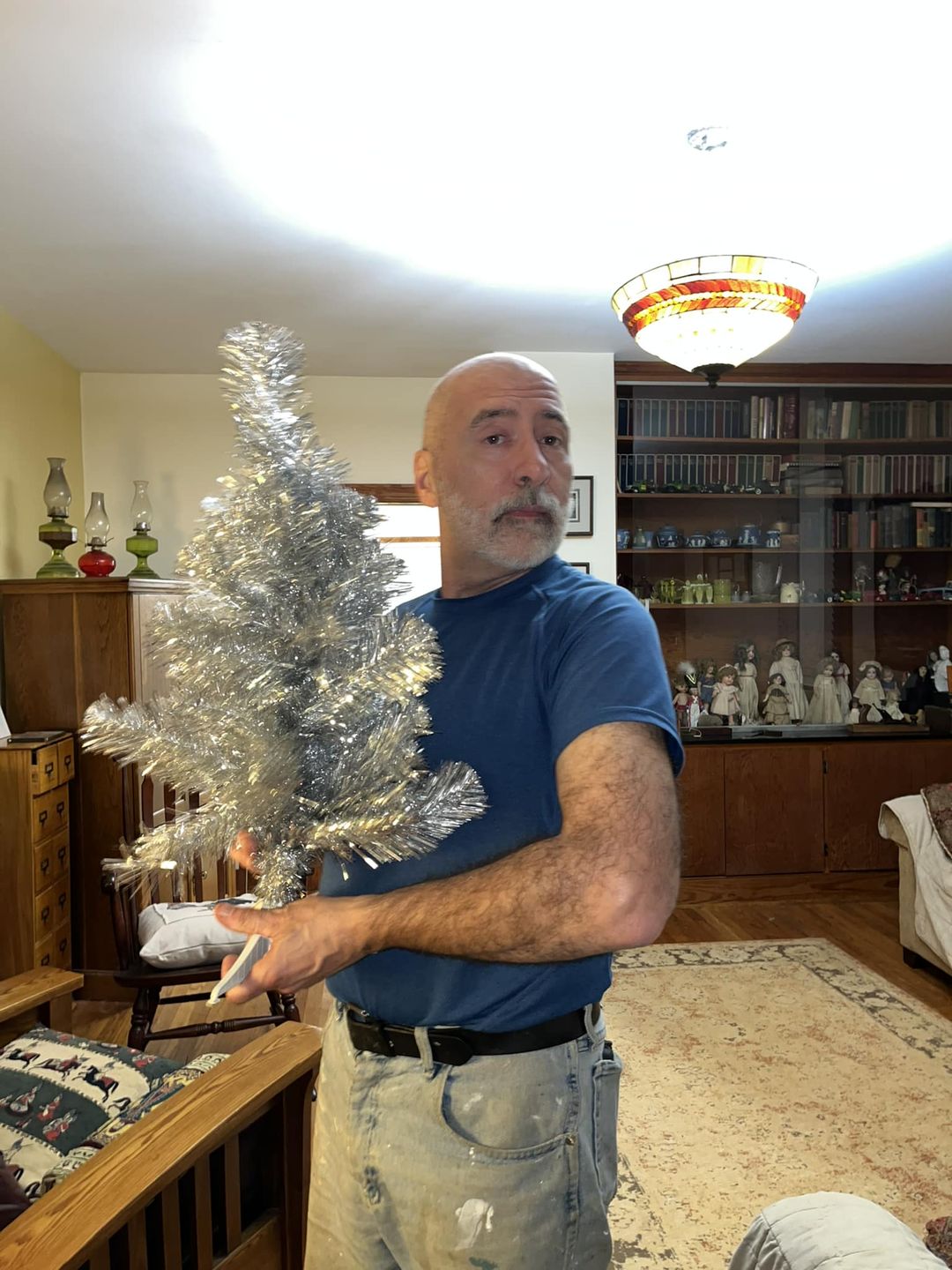
1) Go Lucy van Pelt, not Charlie Brown. We bought, in a moment of irony, a silver tinsel tree. It's only 2' tall but it evokes childhood memories of the basement of Standard Drug in what is now Richmond's Carytown. The basement was only open in those years for the holiday season, stocked with toys and a lot of aluminum trees in one corner. The drug store put out a really nice winter wonderland, with fake snow, lots of ornaments, and colored lighting. It was magical to a kid, especially blue lights on the silver trees. The whole idea of metallic trees fell from favor for many decades but now it's BACK. Mind you, today's fake trees are Chinese made, not from a factory in Hoboken or Sheboygan or San Diego. 

2) Spend a lot on a really nice artificial tree. Not in the mood for a shiny pink aluminum tree, Charlie? A quick look online to find realistic-looking green trees ranging from 200 to 2000 dollars. To be honest, the mid-range ones appear fantastic. Look for ones that are not too regular; I saw a tree for nearly $2000 that had every branch shaped identically. Real trees do  not look that way. Once  you find the right tree, however, it could last you decades. Amortize a $400 tree and you might spend 20 dollars for each of 20 seasons. That's a quarter what a tree-lot example costs, without inflation. Like my tinsel tree, these trees do not need water and won't drop needles.

3) Plant a live tree and decorate it outside. If you have the yard for it, a 6' evergreen can come your way for under $150. For five years or so, until it gets too large, you can add lights and all-season decorations. If it's a dwarf conifer, you might be able to make it your Christmas tree for decades.

4) Get Your Goose (Feather). There's a German tradition of the "Goose Feather Tree" I only learned about today. Take a gander with Mr. Google or Mr. Bing or that Duck Duck Go fellow. The original Goose-feather trees were created by dyeing feathers green to simulate branches, then attaching them to a trunk. You can buy them ready to assemble today, at decent prices. They don't have the density of Fraser Firs, but the sparse branches let you show off large ornaments.They look quaint and cozy to me, like a Walton's tree John Boy brought down the mountain.

5) Become a Druid. A friend who studied modern-day Druidry had a bare branch in her home, beautifully decorated. It evoked the slumber of our current season. It was striking to see and when Yuletide ended, it could go in the compost or wood stove.

Me with tinsel tree
I am out of ideas.  But have a tree, whatever your faith. It's a wonderful tradition. A Blessed Solstice, Happy Hanukkah, and a Merry Christmas to  you.


Sunday, November 26, 2023

Keeping Our Security System Local (For Now)

Antique Burlar Alarm

I cannot live without a home alarm system. It's just how I roll. Now in the country, it's good to have it include fire notification as well.

Several years ago, after a lightning strike blew up our home security system, the then-giant security firm ADT revealed that it had begun to act arrogantly toward residential customers. We said farewell and went with a locally owned firm, Richmond Alarm. They installed a new control pad, surge protector that ADT neglected, and lower monthly monitoring fees.

I consider a good home-alarm system as essential to my peace of mind as clean water. Richmond Alarm had been around a century and seemed unlikely to be going anywhere.

Then they vanished. An out-of-state firm purchased them and swore nothing would change. Within a year, an internationally owned company called Johnson Controls took the helm, outsourced customer service to an Indian call center, with nice but poorly trained workers who read scripts. I began to get voicemail reminders multiple times monthly from India, reminding me to pay my invoice. I blocked all the numbers.

I've never missed a payment, and we auto-pay. Meanwhile rates went up and local employees got the boot.

Now we are about to give Johnson the big farm boot. We considered DIY options from Nest and Ring, but in the end, our setup is complex, covering out-buildings and our home, while our data caps low. We lucked out finding a firm whose headquarters is a few miles from our farm. They can reuse most of the Johnson hardware and upgrade a few dodgy sensors to communicate with our control panel and phone apps.

All that with no hit on our puny WiFi internet data caps.

The moral here? If you live rural without broadband and need a security system, your options may be limited. Starlink's base plan provides 2 TB of data a month, as compared to Verizon's 100 GB. We don't stream media except a movie every few months. We don't watch TV series (unless we can get a DVD). The guy from our new provider looked at us like we were from outer space, but then he said "Starlink would be perfect for you if you add a doorbell camera." 

That may be down the road, or even a DIY setup. Security systems are not cheap, and monitoring is a monthly expense, but the price of a break-in is years of trauma.

Right now, I'm thankful to have a local option again. And I'll be in line for a Starlink antenna.

Image courtesy of Lorie Shaull at Flikr

Saturday, November 11, 2023

A (Darn Straight) Right to Repair

Closeup Tire Rotation

 I have begun using the term "stealership" when referring to the automotive dealers' service centers.

Granted, I know some dudes at Mini, and they have given me sweetheart deals over the years. They knew I'd be coming in to buy another car, eventually. Granted, I used to know a tech or two at Honda, before I got the chops to fix on my own the two CR-Vs I've had. But, still.

 With my wife's 2019 Toyota Tacoma due for its first non-free service at 30K miles, I asked her to get a price on the work: oil change, filters, checking differentials and transfer case, lubing the few points on the chassis that are not sealed. Price? Nearly 300 bucks.

"Get out," said I, looking at the owner's manual. I knew that I could do the same work for a lot less. I made a list, because modern companies still give you a maintenance schedule in your owner's manual. Use it.

The 30K Repair list

This post is not a "tsk tsk" for those of you who don't have tools or time to DIY maintain your rides. I have been blessed with an inherited lift we got back in service last year, time to learn how to use tools, plus a decent collection of same. I write for an automotive publication. I should be able to turn a wrench by now.

My family was famous for its mantra "call some guy!" I've written recently about this philosophy. My mom's brother-in-law, Carlyle Rourke, resisted it. He had a 1964 Mercury Comet 4-door that he kept into the late 1980s. He did everything on that car, and when my first Buick Apollo needed an oil change, he showed me how. My old man told me "get a real mechanic to check your work, boy." I told Pop that if the car was not puking oil into the street, and the dip-stick was right, I'd just take my damn chances.

Today's vehicles are a long way from that Comet, but there are many things one can do on modern vehicles, and thank you, YouTube mechanics, for showing us how. For Nan's truck I soon had torque-specs for all the bolts I'd need to tighten, techniques for doing things without spilling oil on myself (here I failed. Toyotas are odd that way), and so much more that would put you to sleep if I listed them.

Like the OCD person I am, I wrote it ALL down in order of service, with numbers for torque specs beside each item on the 30K list.

With three hours of backache-inducing work, it all was done. I did have to order sockets from Amazon in sizes I didn't have. I tried local businesses but they either put me on endless holds or told me I'd have to buy a set.

Pffft. I got next-day delivery from Bezos' company and a good price. At the end, for $76 including the half-case of Amsoil 0w20 plus filter and Toyo-specific filter-wrench I needed for the oil change, I handily came in at 1/4 the price of the dealership.

Now that many states are pressing for right-to-repair laws, may I humbly suggest you go to Harbor Freight or Northern Tool, buy a cheapass set of wrenches, and watch some YouTube videos? See a few how-to examples at other sites? Some of them have wonderful senses of humor.

Smart-ass Internet advice for fixing the car, but accurate!
It's the 21st Century version of sticking it to the Man. Come bust a knuckle or two with em.

Weeds And My "Carboard Hack"

One day a former neighbor came by to help with something. He said "I saw you out front weeding around your trees. I like your cardboard...