Sunday, June 20, 2021

The Idiocy of Rural Broadband


Here I am, a hypocrite. Yes, me.  I long have celebrated the pokey "cup and string" Internet out here as a great reason to live in the country. 

The typical rant: After all, fiddly-foo, brain-addled screen addicts would lack the data to live their zombie-halflives here, and thus they'd stay in their Stepfords and other boring cul-de-sacs.

End of rant: That all sounded great until I got de-prioritized in January after 100GB of data, because the pandemic and a medical problem have me working from home. Zoom uses a chunk of data, even without HD video enabled.

Throttled

The other satellite provider here offers an even lower strangulation point: 50 GB per month. My old plan with 50, plus the option to buy more priority data, has vanished. There is no cable out here; I even called a cable monopoly I absolutely despise, just to check.

This was looking grim: I could teach from my hermetically sealed campus office, but that meant getting close to undergrads I simply do not trust. Until I had my vaccinations or a good prognosis from my doctors about some tests for prostate cancer underway, I was not going back to campus.  We knew one person hospitalized for COVID and two others now in a graveyard. By semester's end, a quarter of my students would have been found positive, about half had been in quarantine because of exposure, and one landed in the hospital with a throat swollen shut by COVID.

Data strangulation sounded better. We'd figure something out.

I reasoned that there had to be some other option aside from watching the data-count creep up to 100, then the Internet slow down to a crawl.

Enter, BOIP

This sounded promising, "the technology infrastructure company that economically and efficiently delivers high speed broadband access and computing services to underserved and distressed residents on behalf of civic organizations and community stakeholders."

 Small firms like BOIP (Business over internet protocol) offer a WiFi router for a home network, and they have contracts with major carriers such as AT&T or Verizon to get your home the precious data.  The router must be purchased for about $300, but it can be returned for a refund and the contracts are month-to-month.

They bring broadband via a cell tower to a box in the house that looks like an alien critter. If you know satellite Internet, you know how weather and other factors influence latency: speed lags below what would otherwise be optimal. BOIP's tech person and I talked 0s and 1s for a bit...several bytes actually (Hah--I know enough UNIX to be dangerous to myself) and he claimed that it would provide a consistent signal at a speed that might be slower overall than satellite at its best, but without latency: enough for Zoom, streaming films, and ordinary applications.

No data cap, no strangulation point. I was certain there would be a catch. Everything in this sad world has a catch, from the doctor paddling you for that first breath until the final clacking of the casket lid.

Exit BOIP, Enter UbiFi

The catch was the carrier BOIP uses. After about 2 months, disaster. 

The folks at BOIP are as nice as they can be, but suddenly they lost the carrier they'd been using. We got an apologetic e-mail with 72 hours notice that we might lose Internet.  I asked on our local county group, and this was not the first time BOIP had this issue.

We were teaching remotely. I tried to be as civil as I could be, but I called BOIP and said, basically, "heck no. What are my other options?"

They didn't know but were trying as hard as possible to find a new carrier. So I looked around, and I found a national rural-WiFi service, Ubifi. I bought their router installed it doing stupid-UNIX tricks, and in ran it alongside BOIP for a month. Both services cost us $99 per month.

Same speed, similar latency, but one difference: Ubifi has a contract with AT&T and are big enough to merit the behemoth's favor. BOIP scrambled and found someone new to host them. We kept their alien invader, too.

So there we were: two routers going, comparing services. After a month, I returned BOIP's router and got a full refund for the device. 

Lessons Learned

If you are not good with arcane computer code, you may want to pay someone to install a WiFi router for you. I did it myself for Ubifi; BOIP came to the house and advised me on location and setup (which they did for me).

In the long run, something better will emerge than WiFi. We'll have Elon Musk's space empire Starlink service, 5G WiFi, or orgone-ray generators to get us our episodes of All Creatures Great and Small.

Any of them, including our current service or BOIP, prove cheaper and faster than conventional satellite. Data throttling is an evil thing. Rip that dish out of the ground. I cut mine down with a Sawzall.

 Now if we just have enough firewood for all this home-office stuff. My wife is retiring and I will work more from home in Fall, even though I return to in-person teaching.

 Next year, six cords. Period. And take those pills the doc gave me. No cancer but I'm on yet another old-guy diet.


Thursday, May 13, 2021

The One Garden Tool You'd Keep...


We all have them. For a while, it would have been my Japanese gardening knife, or hori-hori. Then I got another Japanese tool, a really nice small pick. They can open a hole fast and mix dirt, break up clods, turn in fertilizer, ash, or green sand.

As the pandemic wanes and I have free time after a busy academic year, I hope to write a bit more frequently here. And nothing charms me into scribbling like the right garden tool.

As much as the hori-hori beckons (we have at lest three) I adore a good trowel. At Herbs Galore 2021 (back in person, hurrah!) I found the booth for Down the Garden Path, a local shop I love to support. I've written here about snips I got from them. Used them today to cut some lettuce for dinner.

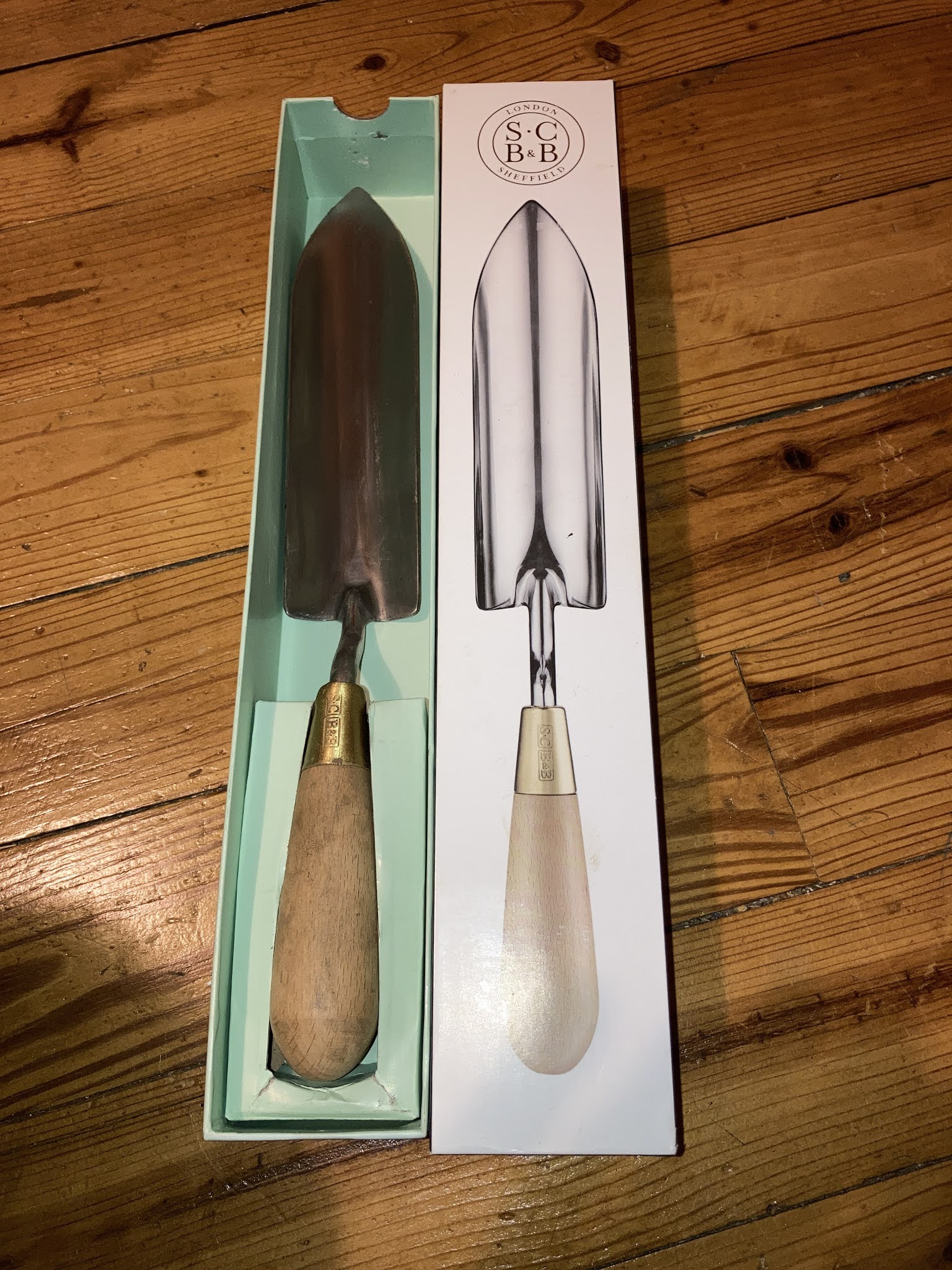
 You won't find the trowel on their site (yet) but contact them to ask about this tool. It can be found at the UK Web site for the brand as well. I've not checked shipping from there to here.


From the show I brought home a really nicely made trowel, a "Sophie Conran Burgon and Ball Long Thin Trowel" model. At first glance, it looks better made than my old favorite, an English-made Spear and Jackson that cost twice as much.

It's Chinese-made but to the highest standards, which surprises me as Chinese tools are often cheaply made. I expect to get years of hard use from it. So what makes for a good trowel?

  • Heavy metal that is stainless or powder-coated. My Spear and Jackson trowel as the latter and this one has more metal and a Black Sabbath show. If a trowel bends, it's cheapass and toss it!
  • Blade with tang deeply set in handle, with a snug collar. The collar (ferrule) has finally failed on my Spear and Jackson, after two decades of use. While I attempt a repair, we'll see how the new trowel holds up.
  • Ergonomic handle and balance in the hand. Like a fine revolver I use for target shooting, a trowel should have woodwork that fits you and balances when held. It should not be too light or heavy. You'll know it by feel.

We shall see how this beauty holds up over the decades. I plant things FAST, getting a seedling in in 20 seconds or so.  You need a good tool for that, especially when the ground gets dry. Other than bringing my tools inside, I do not baby them.

Sunday, February 7, 2021

Combustion v. Capacity for Firewood: If it Burns, Burn it! Part Two


Some time back, I discussed the ways to properly burn really old wood, softwood that is seasoned, and less desirable hardwoods. Let's revisit that idea, as recently someone worried recently that I do indeed burn pine.  It can be safe to do, but you'll have to season it and burn a lot more wood in an year.  The numbers bear it out.

I will revert to my failed attempt to be an engineer, just for a moment.  Values follow for the combustion values of different types of firewood. Here are a few that I burn, copied from an excellent resource with many types of wood listed:

  • White Oak: 47.2, 4010, 25.7
  • White Pine: 26.3, 2240, 14.3
The first number gives density (pounds per cubic foot) of dry wood, the second the weight of a dry cord. The third measures heat value in millions of BTUs/dry cord.

A cord, incidentally, means closely stacked pile 8' x 4' x 4'.

Imagine a pile of logs, closely stacked, 32' long by 4' wide by 4' wide: four cords is what I project to burn by mid-March, when our heating needs ease to "morning and after dinner warm ups."  By early April, we'll stop. Yet we barely have enough wood in the barn, because we are home more, all day for me, during the pandemic. My wife retires this year, so next winter, she'll be around all day. 

 Where to find all those BTUs?

Hickory and Hornbeam are even better heaters than oak, but I don't have access to either in any quantity. Poplar, a common hardwood on our land, does not rate a listing but it's a light soft wood and closer to pine than oak. Maple, somewhat plentiful and Beech, more plentiful still, fall much closer to oak. Naturally, I try to mix in the softer stuff with the harder wood, to get the stove to its peak efficiency.

With pine, I need 1.8 cords to equal 1 cord of white oak, if I want the same heating value. Red Oak, a tree we have and I love to see in the forest for its stately height and shape, is not close to White Oak but more efficient than White Pine. Not all Pines are equal, either. Learning to identify trees provides a nice side-effect of learning to run a wood stove.

Firewood when purchased should be hardwood and seasoned, period. Don't pay for pine unless that's the only thing that grows in your area; many Canadians and Scandinavians have managed to stay alive for many winters burning it. I only use it because I cut so much of it, maintaining our property, often after a huge pine falls in a storm. Gradually, we are eliminating all pines on the edges of our roads.

For the outdoor fire pit? Pick up anything dry off the ground. Use what is left over in the barn. As farmer and friend Dominic, paterfamilias at delli Carpini Farms, likes to say "If it burns, burn it!"

Whatever the wood, the goals are simple when heating a building: avoid a chimney fire from creosote buildup and, as a distant second, not run out of wood. At worst, dealers will deliver but it's going to cost more in what passes for deep winter in Central Virginia. One retired neighbor runs a firewood business, but it pains me to buy wood.

Our house will stay warm (66-70 degrees downstairs, for us) if our stove shows 450-500 degrees F. Any green wood runs the risk of creosote, but seasoned Pine is no worse than any other seasoned wood if the stove maintains a hot-enough fire. Our evidence? Close inspection of the flue during our annual chimney sweeping.

This winter, not bitingly cold but consistently below 50 degrees, has meant that we have burned more wood than in any winter when we've been using it as a primary source of heat. 

I want to increase our firewood storage for 2021-22 by 50%; that's not a problem, as we'll just build a few more wood boxes outdoors for the fuel to season; my new run-in has other uses and is not ideal for wood storage. For the first time, I'm cutting down healthy trees, too, but I'm picking crooked and leaning ones and retaining straight trees that could make good lumber while providing shelter for animals. Another consideration nowadays, with climate change causing more frequent and more severe storms, has been to limit blow-downs and chain reactions when one occurs. That's a subject meriting a future post, but I'm still learning.

In our woods we have many small beeches growing right against each other, and I plan to thin several that are 30-40' tall this Spring. They will season for 9 months. As we fell pines, I factor in needing a lot more of it.  We cut 20 small ones in early Spring 2020, to fell leaners and clear thickets as we expanded our chicken run and dog run back into the shade of the hardwoods. That pine seasoned well but burned fast; I'd estimate we had a full cord of small pine logs in November but nary a stick now.

These lessons about woodlot management came from an expert. I heard Joel Salatin talk at length about the subject when we visited him at Polyface Farm. Joel took us greenhorns around in his woods and talked about how many rural landowners squander a renewable source of energy, shade, and wildlife habitat by not managing second-growth forest properly.

His woods look idyllic, but they are working woods. If you own woodland, go visit Polyface and see what Joel is up to. He's a character but every working farmer I know is one. Comes with the fresh air and woodsmoke, I reckon.

This year, when the stove is cold for months on end, I will be on the lookout for books presenting Earth-friendly, sustainable methods on managing woodland.

Thursday, December 31, 2020

Silk Purses & Sow's Ears: 2020, Farewell


To write this post I decided to look back at my first post for this blog, where I decided that I'd not get political or snarky. I think I've avoided politics, anyhow. In that first post I also said that the tone would be positive here.

Thus this farewell to 2020, a bad year by most accounts, but I'd claim that 1862 or 1942 were far worse, existentially. What can be said good about a difficult year?

First, if you are reading this, consider the alternative: you might not be around to read it, right? Second, think of stuff we get to leave behind. COVID is still with us, along with economic malaise, racial tensions, and the urgent problem of climate change. But one thing is leaving us. Yes, I'm thinking of one particularly hateful person, a walking toxic cloud of entitlement and narcissism. May his remaining days on this planet be miserable. Nuff said. Begone.

Third, think back to the good things you managed to accomplish. I focus a great deal of the DIY infrastructure of rural life here, so I'll share one odd project that changed me in 2020.

We've been gifted (cursed, I'd have said in 2013, when Tractorpunk began) with three 40' shipping containers. One has a broken back, and the rain comes right in. I tried for years to be rid of this thing, and I hated even looking at it. We could not give it away, as we'd done with a few other white elephants on the property. Here's an old truck body, once a den for foxes and discarded cabinets now hanging on the walls of our utility room (the cabinets, not the foxes).


For the 40' container, no roll-back truck was going to stop by to get it. I'd contemplated bringing the shop class down from the community college nearby to cut it up, so they'd get practice with their torches.

Then it hit me: that container would work as well as the other two (spanned by a roof to make a run in) if I could stop the rain water from getting in. I kept looking down at it from the barn roof we were coating with a sealant. I don't know how many times I said "you know, we might be able to do something with that stupid thing..."

So first, I cut a hole in the side that I optimistically called a "door" and walked around; this made life easier, as the container's doors are so heavy that the Incredible Hulk would grunt, opening them. A puddle of frozen water had collected, but the wooden floor was solid and I figured we might as well improve it for dry storage.  


To make a long story short, look at the photo that leads off the post.  With my farmhand Quentin, we stretched a line to find level, then built our own rafters and put them atop sill boards; we used old lumber and scrap for 90% of the build. We got everything straight to within 1/16" of that line, and mason lines do not lie when they are taut.

Once we had a metal roof connected to posts set in cement, I had an equipment shelter for plows, disc harrows, and other implements that had been slowly rusting in the rain. Now they are on dry gravel where I can wire-brush, prime, and spray the lot with a coat of new paint. I'll be able to back the tractors up easily to each and attach them for field work.  Others gave sage advice: Jeff, thanks for the reminder that a a fascia board in front will prevent sag between the posts. I found some old boards today in the lumber room that will finish the job.

This transformation of a hated item took a long time. For six years I'd glowered at the damned container, until one day it hit me: make it useful. Why did that take so long?


If you know me, you know I relate to places and objects better than I do to people. Working on stuff brings me joy, as does travel or the allure of timeless landmarks from my childhood. Conversely, too many people are energy-vampires. I just told a friend from my teens who wanted to reconnect "no thanks." I'm not that person any longer and I don't need a "friend" who is only going to draw upon shared memories of our 20s. I was glad to be shut of him, back then. Again, begone. The years are shorter now.

Yet I can be wrong here: even people can change, like that container. Everyone is wearing masks, now. That heartens me.

I'm not sure which J-Bolts, bags of cement, and treated boards would do the trick on a nasty or willfully ignorant human, but those of you with better people skills, don't give up trying to help them, to stop the leaks and frozen spots.

I say that as a guy who turned 60 and now has a couple of long-term health issues. But maybe the next 25 years (if I'm lucky) I have left won't be so miserable as 2020?  The Science-Fiction-sounding year 2021 dawns with a bit of hope, with longer periods of daylight, and a vaccine.

Let's get busy building something worth keeping.

Monday, December 14, 2020

COVID-19 And Six Acres of Solitude


I want to begin by making one thing clear: I want this terrible pandemic over. I feel sorry for those whose lives and livelihoods have been hurting.  No snark forthcoming. It will be a blessing to us all to have a vaccine widely available.

This post will discuss, briefly, my enjoyment in solitary pursuits, and give some tips about field management from a decidedly novice point of view.

In the relative silence of these months, I realized that I do not miss the pre-pandemic world; even my desire to eat an artisanal meal at a locally owned restaurant has been blunted. Part of my feelings are old habits of solitude, as compared to the more social people I know. As I get older, other people seem to wear me out with their constant neediness and lack of resilience in the face of adversity.

My wife and I have been inordinately blessed to have farm work, and lots of it, to keep us occupied and outdoors during the pandemic. We built two structures, improved our raised beds in the garden, expanded the dog run and chicken run, laid in a winter's worth of firewood, and more. Next up, replacing an elderly tractor's wiring harness and working a young livestock dog into our pack of pups, to watch the perimeter.

One huge project, that I've only noted in passing because other projects leave me little time to post more here, involves cultivating six acres of ten across the road from us that belong to my wife's brother. It's a former farm field where dad, aka Big Ed, used to grow tobacco, then soybeans. It went to weeds and saplings years ago, getting only an occasional bush hogging. Over time any ground-nesting birds vanished because fescue (shame on you, Blogger, for not recognizing that word) crept in and it mats too thickly to permit nesting.

My wife's family wanted to hear whippoorwills again and attract coveys of quail. To that end, I've spend about 80 hours in the past two years running heavy machinery and smoking cigars from the tractor seat (okay, about 4 hours of smoking, I'd estimate). The rhythm of the work is really satisfying in a Marie-Kondo sort of way. 


Last year, a landscape biologist from our Extension Agency walked the property and gave us lots of advice, mostly good. I say "mostly" because even the "organic" method of controlling fescue would still involve several thousand dollars for spraying Roundup or similar around the perimeter. That is a DIY cost, mind you, which meant buying a tank and sprayer, too, in order to block fescue creeping in and to leave an ATV/tractor road at the edge. 

The non-organic method involves spraying the entire field. This would kill all the pollinators, including our honeybees.

"No. Hell no," was my response. "I want that crap banned." That's usually my reply to folks who advocate spraying. Granted, the little bottle of Roundup concentrate I apply with a paint brush to Tree of Paradise is still dangerous, but it's hardly the hundred gallons or so we would need to spray a perimeter.

If we want our ecosystem to endure, we need to get beyond our species' suicidal habit of automatically reaching for dangerous chemicals. Period. So our management plan involved mowing the perimeter very short, then plowing, discing, and sowing the ground with plants that suppress weeds and build up the soil.

During the course of the hours on and off the tractors, I learned about managing for wildlife. The first principle involves contacting your extension agent and getting advice. We got a full management plan, free of charge. 

Even if I don't agree with 10% of it, the other 90% is worth its weight in...wild birds. I also highly recommend, for those in my region at least, a PDF guide, Managing Land in the Piedmont of Virginia, authored by the American Bird Conservancy, Piedmont Environmental Council, and the Virginia Department of Game & Inland Fisheries. Check with your state agency to see what they may offer for your bioregion.

Beyond that:

  • Think long-term: What are the goals for the property in 5, 10, 20 years? 100? I wished we thought more like that about all our land. But it's good to make a plan that can adapt to a drought, flood, or in these parts an actually cold winter. And farmers should make provisions for keeping the land in family hands and in production. That's another issue for another post.
  • Know when and if to mow: We had to mow the fescue before tilling it under, to suppress what we did not want. Weeds were up to my shoulders and that meant mowing. Sadly, I had to do so at a time when fauns might be in the grass. I didn't see any, but I began from midfield and mowed outward, rather than starting from an edge; this let wildlife escape.
  • Not everyone can burn a field: Controlled burns sound great! They mimic what happens in meadow ecosystems, naturally. But good luck finding a crew that wants to take on smaller fields. We were told that below 40 acres, you won't get many offers. So we chose the mow, till, plant method. And for the love of God, don't try a controlled burn if you've never done it. It's a job for pros.
  • Don't make things worse by cultivating: Soil too wet? You will make a mud field and likely get the tractor stuck. I did that once in a low spot. Too dry? It's Grapes of Wrath time, with a mini Dustbowl of your own making on a windy day. I found that following my two-share plow with a disc harrow as soon as possible, then discing across the furrows really worked well. The second time I put down seed right after, and we had rain. The cover crop / green manure sprouted within a week.
  • Plant right to improve the soil while attracting game: Ask the extension agent about a soil test if you are unsure. With our heavy clay soil, we opted for adding nitrogen and breaking up the clay. We planted about 700 pounds of seed in 2 plantings: buckwheat, Peredovik sunflower, and iron-clay peas (excellent in clay, as the name suggests) to suppress weeds, followed by a winter crop of rye.  This all gets disced in the next year as a green manure, before replanting. The next spring, I had a tough time finding the peas so I went with buckwheat and the sunflowers. For this winter, I just cut the field but let the weeds and seeds persist, as I see very little fescue. Next year, I'll disc and sow selectively (1 strip disced 6' wide, skip 12', disc again) to begin attracting birds that require some bare spots of soil to build nests. With foxes vanishing around here as coyotes arrive, we may get lucky soon.
  • Be humble about it all: a neighbor looked out one day and saw a tractor mired, hub-deep, in a furrow. That's because I'd tried to hurry, discing when the ground was too wet. He's an experienced farmer and said nothing, though had the tractor stayed there long enough, I'm sure he'd have offered to pull it out. I should have done it right after plowing...or waited, but no. I learned something about weather and patience. Nature does not work on our schedule. Now I watch the weather, the frost forecast, and the advice of those who know more than I ever will.

By bringing tidiness to the field, what remains sparks joy, as Marie Kondo would say. It also, as practiced, builds habitat for the sorts of animals getting ever scarcer as old fields grow back to forest and active ones are managed with a relentless application of metal blades and poisons. There's personal as well as environmental mindfulness at play. You get you know your inner self when you spend that much time alone without a screen.

You don't need six acres, or 6000, to practice some of these ideas. Spend some time alone on your property without distractions. Then ask:

What would my yard/field/farm/woodland look like if I planted and managed it with the next 100 years in mind? Sounds subversive, doesn't it?

Good.


Saturday, October 24, 2020

Fermenting Fool


Look out, Sandor Katz. I read your book.

Actually, I use his work as reference, as well as many good (and a few dubiously gushing) Web sites to guide me as I learn the arts of lacto-fermentation. What, pray, is that?

You've eaten fermented foods your whole life, if you enjoy kimchi you've had it. Likewise sauerkraut, if it came from someone's kitchen and not a factory jar.

Wikipedia's definition, however, seems to come straight from a high-school chem lab, so I'll try some of the fermentation-fanatic sites for a warmer vibe. Here's a nice definition by Danielle at Fermented Food Lab:

 Lacto-fermentation is the oldest form of food preservation in the world. It involves only salt, water and vegetables. The salt water brine creates an anaerobic environment (free of oxygen) where only lactobacillus bacteria can survive. The lactobacillus bacteria act as a preservative, keeping harmful bacteria from living in the ferment. 

Yes, I too was dubious about this entire business, imagining a lingering death. I've drunk kombucha, mostly out of courtesy to those insisting it is the drink of immortality. Save for one or two times,  I found it dreadful.

My purpose in fermenting things has been to make great ice-box pickles, kraut I can, and the holy grail: golden pepperoncini, my food of the gods. This season I fermented other peppers, notably jalapeño slices and Thai Dragons (whole). For really hot peppers of that sort, fermenting takes the edge off the heat.

I don't offer recipes here. To get started, however, you can consult my gold standard: The National Center for Home Food Preservation. No New-Age mysticism or miracle cures there, just trustworthy advice that will not make you sick. Start there for pickles and kraut and basic how-tos. After that, venture into the briny wilds of the Interwebs. Experiment, carefully.

 Suffice to say I've learned a few things:

  • Adding a grape leaf to the fermenting crock helps keep veggies crisp.
  • Fermented foods store in the fridge a long time. I do add a bit of vinegar to the top of the jar, heresy to some who ferment but one of my favorite ingredients. My kitchen, my rules.
  • Hot, humid weather really shortens the time needed. My ferments in Fall take take several more days. Keep the crocks away from sunny windows, in any case.
  • Brine matters. I found an excellent online calculator you might wish to try, to get the right percentage of brine for your crock.
  • Cheap Morton Kosher or Pickling salts are excellent. Perhaps pricey sea-salt would change things, but my uncultured palate barely can sense a difference. Just do not use iodized salt. 

If you find a good recipe for crisp, flavorful okra, let me know. That was my only fermenting failure this year. And how I love okra.

Saturday, August 22, 2020

A Recipe for Middle Eastern Tomato Sauce


You have a garden or farmer's market. Use them, and learn to put up food. It's a great benefit of the extra time we have now during this pandemic.

 I was asked for this, and every year I have enough tomatoes to put up about 8 pints, if not more. This will make four quart jars for canning...maybe.

  • Gallon pot of tomatoes, any kind, cut up (Romas and similar will make a thicker sauce). You can peel them if you wish. I don't
  • One onion, chopped
  • Six cloves garlic, or more, minced
  • Green pepper chopped small
  • Tablespoon of dry oregano (use less if chopped, fresh)
  • Other dry herbs such a basil (tablespoon, crushed) or thyme (up to a tablespoon, crushed). Use less if chopped, fresh
  • Teaspoon cinnamon
  • Teaspoon allspice
  • 1/2 teaspoon black pepper or more to taste
  • Teaspoon salt or more to taste
  • (Optional) 1/2 teaspoon hot pepper flakes.


That's really it. I often cook the tomatoes down a bit first, bringing them to a boil in a heavy dutch oven, then pressing them down with a potato masher to release the juice. The trick is very slow cooking, and I let the sauce simmer on a simmer-setting burner, with the top tight or just loose enough for steam to escape.
 

Watch the pot and stir occasionally to avoid thing burning. Cook until thick, at least 8 hours!

This makes a great base for lots of Lebanese dishes and it can also become chili con carne, pasta sauces, and more. 

I brown ground lamb and add it, then serve it over basmati rice. Or chop and fry up some okra and add it. You can't go wrong.

It cans well, with the water-bath method.  One thing: be SURE to follow recipes well, including adding citric acid or lemon juice in particular! Granny had more acidic tomatoes than we do today.

Update 2022: I now use a pressure cooker method recommended by The National Center for Home Food Preservation. Their spaghetti sauce recipe is closet to this one in terms of processing safety to avoid botulism.

Delayed Gratification and Wasted Money

I hate gambling. I think it preys upon the poor and the impulsive. It reveals a deeper problem. When I saw a young man in the convenience st...