Thursday, December 16, 2021

Aluminum Ladders and "The Elements"


 This short post, as a tough year nears its end, may be a valuable one for anyone with an aluminum ladder.

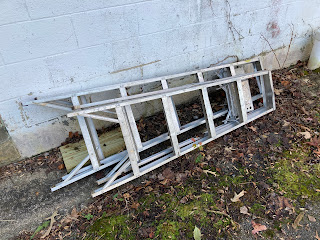
The two examples pictured will soon go to the metal recycler, though they look fine. Why? They've been exposed too long to heat and cold, and for aluminum ladders, as we recently learned, that can mean failure. The shorter of the two began flexing dangerously where it folds.

I began to get paranoid after a 3' step ladder we'd kept outside in our hen yard broke, resulting in my wife getting a fracture. Careful inspection showed the front legs failed where a pin went through the metal, precisely where the ladder folds.

Now we are keeping all our ladders in buildings and not in the sun or exposed to freezing weather. Yet a cursory Google search reveals web sites that say storing metal ladders outdoors is fine, while others advise against it. No one in their right mind would store a wooden ladder outside, and I suppose fiberglass will degrade under UV light, too.

I took enough Physics and Chemistry classes to understand how metal expands with heat and contracts with cold. Over time, hairline cracks form in aluminum ladders, at joints of folding ladders in particular. I'm now going to inspect our folding ladders annually with a magnifying glass at each joint, and the extension ladders where the clamps lock or pivot.

You know those click-bait ads that talk about "Learn this one simple trick for..."? Well, here is one for ladders, DIYers. Get them out of the elements. I'd not leave extension ladders out, either.

Since Canada is infinitely more sensible than the US, advice from Canadian agencies on ladder inspection proved easy to find and far clearer than OSHA's legalese. Check here for Canadian basics when checking both extension and folding ladders. Werner Ladder has a YouTube video here.

Life is short enough as it is. No need to hasten the process. Get your ladders into a building.

Here's to a better 2022!

Thursday, November 4, 2021

Sometimes, Local is the ONLY Choice to Make


I recently wrote about how Big Boxes and Amazon might save the day in certain circumstances. 

Not always, and before you say "ah, the nut is contradicting himself" let's recall Emerson's dictum that "a foolish consistency is the hobgoblin of little minds."  I may be foolish, granted, but I know a bargain when I see one.

Consider a Line-O-Tronics 315 lift I inherited when we bought this house from the estate of my wife's parents. The lift is a serious piece of equipment, a model found decades ago in professional auto shops. It will lift any vehicle we own, for prosaic oil-changes and serious work on the suspension.

My editors at Hemmings Motor News get poetic in their many articles about lifts. I aspire to write for the old-car hobby, and a lift makes one a contender rather than just a dabbler. So I was delighted to have it. 

Then, a few years back, it broke.

I'd made do with another lift nearby and a grease-pit, but the time came when the other lift in our old shop was tied up, long-term, with a car being restored. I needed to fix my own darned lift. We had the hydraulic cylinder that lifts a vehicle repaired, with new seals installed, to the tune of $300. My patient brother-in-law, who will get usage rights, wrestled it into place. We got the amperage correct for running the motor, upgrading our breaker servicing the lift.

Still, the unit's pump and motor needed servicing. The arms of the lift would not rise, even without a car on them. Being addled by the ease of Amazon, I decided "let's buy a new one!" It sounds expensive to the non-gearhead, but $400 for a motor and pump is not a big deal as replacing a lift would cost many thousands for something comparable to the old unit.

Then the shortcomings of algorithms, trans-Pacific supply chains, and infinite marketplaces reared their heads. Amazon features dozens of motors and hydraulic pumps, almost all Chinese built, but some of them do not note the dimensions of the units. That won't fly, as I've only a few spare inches of clearance when installing a new motor and fluid tank. 

Incidentally, the installation is no harder than many simple jobs, but the unit is heavy. So I asked Amazon's seller to tell me the specs for the unit I was ready to buy.

Crickets. I asked a public question and got an automated response in 48 hours saying, more or less, "no one has answered your question and that means it probably won't ever be answered."

To hell with Amazon. I started thinking that the old unit might be repairable.

I found Hesco, a local hydraulics firm, calling them about the repair. I got a live and friendly human on the phone, and I got assured they'd fix the thing if they could. I might be out $90 if it could not be repaired.

I hauled the motor and pump to them yesterday. Today I got a call: fully repaired for $106. 

Now I ask you this: should Amazon still be our first choice for every serious purchase?  

Jeff Bezos does not like to hear things like that, but maybe we should start saying such things more often. If Bezos can send William Shatner to the verge of space, he can set up a system that makes a seller give us the dimensions of an item we are to purchase.


Friday, August 20, 2021

Keep a Lid on it! The Right Lid.

Tattler reusable lids at work

My year in the garden has been "interesting," as in five Copperhead snakes in with our animals or at my feet, suddenly.

I thought my post would be about snakes, but there's something far more lethal in many homes: canning lids. 

We do a lot of canning every year: four gallons of Middle-Eastern tomato sauce, strawberry and fig jams, sometimes pickles. I go through a stack of lids.

During the pandemic, more than a few friends decided to try home canning. I've long extolled the virtues of the National Center for Home Food Preservation, my go-to for canning advice. Yet they are silent about something that happened to me the first time this year: cheapass canning lids.

In the Fall, a massive shortage of lids emerged. It might have been the prior President's stupid trade war with China, with its associated bottlenecks. It might have simply been demand. In consequence, I bought a bunch of lids from Amazon, and several in each batch this year have "buckled."  Read more about the phenomenon here. The food is still good, but the jars must be processed again or put in the refrigerator.

Buckled lids. Re-processed with Tattlers

Eating from such a jar after it has sat on a shelf a while? It might prove fatal. 

I'm relegating my cheapass Chinese bargain lids to the storage of dehydrated foods in mason jars I keep in our freezer, for stockpiling dry beans, lentils, rice, and other staples with an oxygen-absorber pack. For canning? I'm again experimenting with US-made Tattler reusable lids. I've had some for a while, and I found that when one follows their directions exactly, they work wonderfully for up to a year (I usually eat my canned food by then). Some users of the lids complain about them not sealing, but I suspect they don't read directions well. We have yet to have a problem.


My other fall back? Paying high prices to get a couple of boxes of Ball-brand lids. They have yet to fail me and though the Muncie, Indiana plant has closed, the products are still made in the US and Canada. They will be there if the Tattlers disappoint.

Does all this rage matter? Yes, and not for geopolitical reasons. The Chinese lids are often lower quality, and there are reports (well, it's the Internet) of scam-lids made to look like Ball lids but made to lower standards in China.

So spend a few more bucks on a trusted product. Boutulism? Now that is expensive.

Tuesday, August 17, 2021

Local is Not Always Good.


Readers, can you believe I wrote that? Recently I’ve had an experience with a store I praised here before, Pleasants hardware. In several cases they have stopped carrying items that I need for the farm and I’ve had to resort to Amazon, Home Depot, or Lowe’s.

What’s up? I would pay a buck or two more to support a local business, but when, in three cases, Amazon or a big box had what I needed that day and at a competitive price, I did not hesitate to buy there, especially when shipping is free via my Prime account.

Luckily, we have more than a few local options still in business.  A little hardware store called Lacy‘s in Goochland County had some security system batteries Pleasants no longer carries, and these cost half what Amazon charges. So I drove up there and got them today. We also bought a Speed Queen washer from Lacy’s during the pandemic, when all our other options were out of stock. 

Check before you buy, too. An amazing lumber yard called Siewers (pictured above) provided high quality beaded-board ceiling and paneling for a new project here, and every employee, from the counter guy to the loader, was knowledgeable and courteous. The product is superior to any millwork from a chain store. 

 I think if local places want to stay in business, they need to really provide the best customer service around, something that may not be easy to do during the pandemic. The woman who answered the phone at Pleasants today said “hello Kroger‘s.“ That greeting spoke volumes; Pleasants is now hiring anyone with a pulse.

What is to be done? Tell the local place. I told the manager at Pleasants, as politely as I could, “what you don’t carry now I ordered on my iPhone from Amazon,  while standing in aisle 7.”  

I got the item the next day. That manager is gone now. 


Monday, July 26, 2021

Old-School Tools: Walkie-Talkies!


A WALKIE-TALKIE? Get out, you might say, in the era of ubiquitous smart-phonery. 

Agreed, up to a month ago. I associated these devices with the Radio Shack of my pre-teen years, in the 1970s. Yet when my wife suffered a debilitating fall in 2016, on an icy slate, it took me a while to wake up to her yelling for me. I began to consider, as she made a remarkable and hard-fought recovery, whether we might install an intercom system back by our chicken coops. On and off this consideration went, for five long years. Now we have something, but not an intercom. Those serve a certain need, but they are not perfect.

Her parents had an intercom between their auto-repair shop and their house. It came in handy in many regards, mostly for "lunch is ready, Edward!" notices but even altering them to a burglary. They left the unit active 24 hours a day. My tough-as-nails father-in-law went to the shop after the shop's mic signaled a break-in. He surprised the burglars with a shotgun and he told my mother-in-law to call the law. The bad guys dutifully put up their hands (no arguing with both barrels of what I refer to as "Old Painless") until the deputies took them away.

I've no plans for backyard heroism, but we do often have issues with our animals at dusk, usually a hen gone missing but also our too frequent encounters with Copperheads. An intercom lacks portability. Then I began to research walkie-talkies. They have come a long way as electronics evolved and rechargeable batteries improved. We knew that our phones do not have perfect reception from every location on our property, including the deer stands I use in hunting season, when a call for assistance might be essential. Moreover, we could take them to our land in Buckingham, where one needs to do a certain dance on a certain spot to have ANY cellular reception.

I'm not going to recommend a particular model. Take a look at reviews on Amazon and elsewhere. Some offer more water protection than others, including boater models that can survive "man overboard" situations. 

We purchased a midrange Midland pair of walkie-talkies for under $60, shipped. We use the low-frequency band (you pick a channel among 22) for a range of up to 25 miles (high-frequency use requires an FCC license). We are delighted. Just the other night, a Copperhead was cornered by our livestock dogs and I needed to respond ASAP. I got the notice from the walkie-talkie. Most other times, it's simply me (I do the cooking) saying "Queen Bee, come in, dinner in 5." Some things never change. My old man had a CB radio in his Cadillac, when he went to Florida to buy loads of tomatoes. His handle was "Big Joe Tomato." I use that one once in a while.

So far this old-school tool has more than paid for itself.  We never forget to carry them now when one of us leaves the house. We just make sure the other person has their radio and it's on.

 Don't rely on that fancy phone, if reception is spotty and your land has nooks and crannies you walk, hunt, or work. Buy a walkie-talkie and learn to use it. It might save your life.

And yes, I miss the living hell out of 70s Radio Shack. DIY electronics! I should write a post about the drawers of resistors and the soldering irons...


Sunday, June 20, 2021

The Idiocy of Rural Broadband


Here I am, a hypocrite. Yes, me.  I long have celebrated the pokey "cup and string" Internet out here as a great reason to live in the country. 

The typical rant: After all, fiddly-foo, brain-addled screen addicts would lack the data to live their zombie-halflives here, and thus they'd stay in their Stepfords and other boring cul-de-sacs.

End of rant: That all sounded great until I got de-prioritized in January after 100GB of data, because the pandemic and a medical problem have me working from home. Zoom uses a chunk of data, even without HD video enabled.

Throttled

The other satellite provider here offers an even lower strangulation point: 50 GB per month. My old plan with 50, plus the option to buy more priority data, has vanished. There is no cable out here; I even called a cable monopoly I absolutely despise, just to check.

This was looking grim: I could teach from my hermetically sealed campus office, but that meant getting close to undergrads I simply do not trust. Until I had my vaccinations or a good prognosis from my doctors about some tests for prostate cancer underway, I was not going back to campus.  We knew one person hospitalized for COVID and two others now in a graveyard. By semester's end, a quarter of my students would have been found positive, about half had been in quarantine because of exposure, and one landed in the hospital with a throat swollen shut by COVID.

Data strangulation sounded better. We'd figure something out.

I reasoned that there had to be some other option aside from watching the data-count creep up to 100, then the Internet slow down to a crawl.

Enter, BOIP

This sounded promising, "the technology infrastructure company that economically and efficiently delivers high speed broadband access and computing services to underserved and distressed residents on behalf of civic organizations and community stakeholders."

 Small firms like BOIP (Business over internet protocol) offer a WiFi router for a home network, and they have contracts with major carriers such as AT&T or Verizon to get your home the precious data.  The router must be purchased for about $300, but it can be returned for a refund and the contracts are month-to-month.

They bring broadband via a cell tower to a box in the house that looks like an alien critter. If you know satellite Internet, you know how weather and other factors influence latency: speed lags below what would otherwise be optimal. BOIP's tech person and I talked 0s and 1s for a bit...several bytes actually (Hah--I know enough UNIX to be dangerous to myself) and he claimed that it would provide a consistent signal at a speed that might be slower overall than satellite at its best, but without latency: enough for Zoom, streaming films, and ordinary applications.

No data cap, no strangulation point. I was certain there would be a catch. Everything in this sad world has a catch, from the doctor paddling you for that first breath until the final clacking of the casket lid.

Exit BOIP, Enter UbiFi

The catch was the carrier BOIP uses. After about 2 months, disaster. 

The folks at BOIP are as nice as they can be, but suddenly they lost the carrier they'd been using. We got an apologetic e-mail with 72 hours notice that we might lose Internet.  I asked on our local county group, and this was not the first time BOIP had this issue.

We were teaching remotely. I tried to be as civil as I could be, but I called BOIP and said, basically, "heck no. What are my other options?"

They didn't know but were trying as hard as possible to find a new carrier. So I looked around, and I found a national rural-WiFi service, Ubifi. I bought their router installed it doing stupid-UNIX tricks, and in ran it alongside BOIP for a month. Both services cost us $99 per month.

Same speed, similar latency, but one difference: Ubifi has a contract with AT&T and are big enough to merit the behemoth's favor. BOIP scrambled and found someone new to host them. We kept their alien invader, too.

So there we were: two routers going, comparing services. After a month, I returned BOIP's router and got a full refund for the device. 

Lessons Learned

If you are not good with arcane computer code, you may want to pay someone to install a WiFi router for you. I did it myself for Ubifi; BOIP came to the house and advised me on location and setup (which they did for me).

In the long run, something better will emerge than WiFi. We'll have Elon Musk's space empire Starlink service, 5G WiFi, or orgone-ray generators to get us our episodes of All Creatures Great and Small.

Any of them, including our current service or BOIP, prove cheaper and faster than conventional satellite. Data throttling is an evil thing. Rip that dish out of the ground. I cut mine down with a Sawzall.

 Now if we just have enough firewood for all this home-office stuff. My wife is retiring and I will work more from home in Fall, even though I return to in-person teaching.

 Next year, six cords. Period. And take those pills the doc gave me. No cancer but I'm on yet another old-guy diet.
 

Thursday, May 13, 2021

The One Garden Tool You'd Keep...


We all have them. For a while, it would have been my Japanese gardening knife, or hori-hori. Then I got another Japanese tool, a really nice small pick. They can open a hole fast and mix dirt, break up clods, turn in fertilizer, ash, or green sand.

As the pandemic wanes and I have free time after a busy academic year, I hope to write a bit more frequently here. And nothing charms me into scribbling like the right garden tool.

As much as the hori-hori beckons (we have at lest three) I adore a good trowel. At Herbs Galore 2021 (back in person, hurrah!) I found the booth for Down the Garden Path, a local shop I love to support. I've written here about snips I got from them. Used them today to cut some lettuce for dinner.

 You won't find the trowel on their site (yet) but contact them to ask about this tool. It can be found at the UK Web site for the brand as well. I've not checked shipping from there to here.


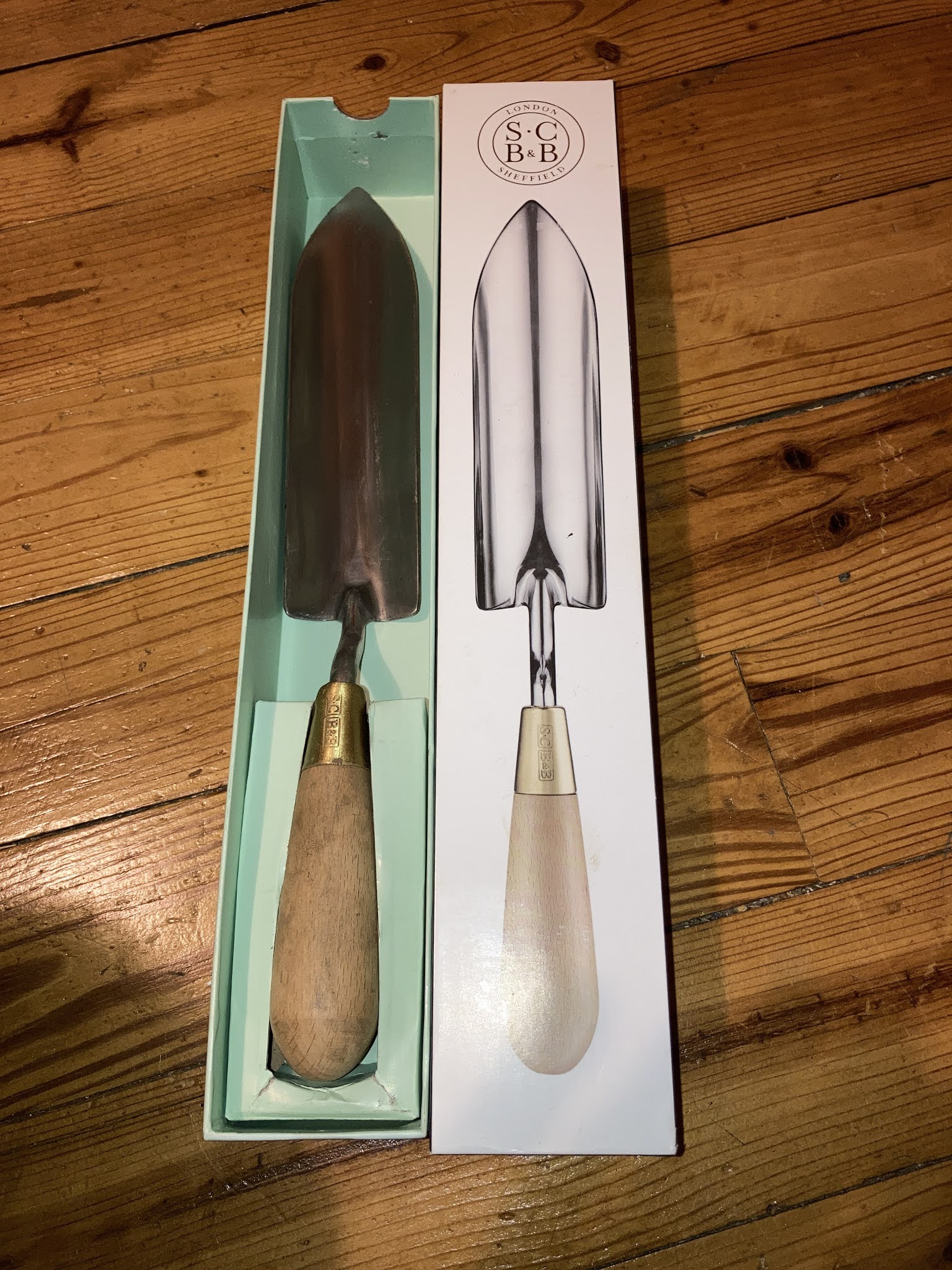
From the show I brought home a really nicely made trowel, a "Sophie Conran Burgon and Ball Long Thin Trowel" model. At first glance, it looks better made than my old favorite, an English-made Spear and Jackson that cost twice as much.

It's Chinese-made but to the highest standards, which surprises me as Chinese tools are often cheaply made. I expect to get years of hard use from it. So what makes for a good trowel?

  • Heavy metal that is stainless or powder-coated. My Spear and Jackson trowel as the latter and this one has more metal and a Black Sabbath show. If a trowel bends, it's cheapass and toss it!
  • Blade with tang deeply set in handle, with a snug collar. The collar (ferrule) has finally failed on my Spear and Jackson, after two decades of use. While I attempt a repair, we'll see how the new trowel holds up.
  • Ergonomic handle and balance in the hand. Like a fine revolver I use for target shooting, a trowel should have woodwork that fits you and balances when held. It should not be too light or heavy. You'll know it by feel.

We shall see how this beauty holds up over the decades. I plant things FAST, getting a seedling in in 20 seconds or so.  You need a good tool for that, especially when the ground gets dry. Other than bringing my tools inside, I do not baby them.

"Call Some Guy!" It Depends

I've not posted since August because of other writing gigs and deadlines, as well as some much-needed DIY work.  I've written here, ...