Thursday, March 10, 2022

Where Have All The Ringshanks Gone?


A bout of COVID, and it was not fun, kept me occupied for far too long last month, so this blog, as well as my DIY projects slipped their schedules. Now that I'm finally putting homemade weatherboard siding up on our addition, in place of hideous, unsustainable vinyl or expensive cement-board, I have a problem.

Nails.

Before the chronic shortages and inflation of our recent past hit, I purchased a Cadillac of nail-guns: a Paslode cordless that uses gas cartridges for framing. It's perfect for doing work from ladders where a long cord to a compressor could prove deadly. My old framing gun blew its seals years ago. 

First, I found that the gas cartridges are in short supply, and I want to save what I have for a Fall 2022 project to expand our hen-yard with a new coop. Second, nail guns can split thin weatherboard at the ends, so I planned to hand-nail every nail after drilling a pilot-hole. We did an entire house that way once; it's slow, meditative, Amish-style work, especially when a family member cut down the trees, ran the logs through a sawmill, helped you strap down and "sticker" the lumber to season, before you planed the boards.

That type of work makes one not waste a single scrap of wood. Not one. I even use the chips from the planer in our hen houses and in muddy spots during the winter.

In times past, I would go to the big-box or local DIY place and find lots of galvanized nails with "ring shanks." These little rings make it hard to remove a nail. That's a pain when taking down siding, but it also slows down the way in which a board exposed to the elements will pull away from the building, warp, twist, and do all sorts of non-linear things after just a few years in heat and cold.

So to Lowes, Home Depot, Pleasants, Lacy's Hardware, and the gem of Crozet VA, Crozet Hardware I went. 

At the small stores they knew what I wanted. At the big ones? Crickets. The problem has been that for years, because of the omnipresence of nail guns, shops no longer carry the variety of hand nails they once did. I scored a few tiny boxes at Pleasants, enough to keep the siding job going. 

No one carries my favored brand, Stormguard, that are USA-made and very reliable. Even I rarely bend any. 

So what did I do? Amazon had Stormguards, of course with free shipping for a five-pound box at a price that did not make me scream. I did not check the amazing lumber-yard Siewers, but I will and buy a few pounds of nails if they have them in stock. 

 For some reason, this situation scared me more than seeing empty grocery shelves and expensive gasoline. When we forget how to hand-nail things, it seems a moment in a slow descent into barbarism.  Machines break. Hammers, rarely.

 My father-in-law, who weathered the Great Depression, never ran short of fasteners: he kept pounds and pounds. Now, I will, too.

 So far, 2022 has had many bad omens. Add this particular shortage to my worry-list.

Image courtesy of QC Supply: stock up! 


Thursday, January 6, 2022

Chainsaw Logic, Part I


So it's winter. We get ice storms and heavy, wet snow that brings down limbs, entire trees. As in hurricane season, this weather sends people who have never owned a chainsaw to big-box stores to buy them.

For many, the next stop becomes an emergency room. Or a graveyard.

But this post is not about safety with saws; it's about the saw to buy if you really think you need one. I've been using a chain saw regularly for over 15 years, a blink of any eye by the standards of my wife's family. I'm still too much a novice to fell any tree bigger around than my leg and 30' tall. After that, I call my brother-in-law. Larger trees that fall I do cut up, even making them roll where I want them. That trick for the experienced sawyer is not something to be handled in this post, either.

No, I want to discuss a topic as sensitive as Ford v. Chevy for pickup owners or Deere v. International when it comes to tractors. I'm thinking Stihl v. Husqvarna.

Why these two?

These two brands are considered premium saws; so is Echo, but I've no experience with the brand, though it's been highly recommended to me.  Down-market brands might be fine for occasional use, and much of what I recommend would still apply.

Three years back, I switched brands to a "Husky" after I found my Stihls hard to operate in cold weather and fiddly to service. Briefly, there are some strengths and weaknesses for either saw:

  • Stihls tend to cost a bit less, and have a larger dealer network in my part of the country.
  • Stihls have a reputation for more power in the same size saw.
  • Husvarnas are simpler machines, especially the starting method and electrics. I found myself constantly needing to remove the carb cover on my Stihls to adjust things.
  • My Stihls were harder to start, and I run all my saws on ethanol-free 93 octane, mixed properly with 2-cycle oil. I run about 3 gallons of gas through my saws and weed whackers each year (operating on average a couple of times monthly for the saws, weekly for the other tools in warm weather).
  • Stihls have really weak gas caps that break easily and two bolts to hold the bar that are easily stripped if you over-torque them. Husqvarnas have a single bolt that goes into metal, not plastic.
  • My Husqvarna needs more attention to keep the chain tight than did my Stihl. Since it's wise to check the chain regularly, this seems not much of a bother. I stop the saw occasionally, check the chain tension, then adjust as needed.
  • The Husqvarna chain-brake system is as safe as Stihl's, but it will break if you try to remove the saw cover with the brake set (I did just that and ordered a new cover).

Much of what I've found has been seconded by another writer.  In the end, and despite its caveats, I'll buy another Husky. I'm going to get a slightly larger saw for "bucking and felling" medium trees.  

So what about an electric saw? Stihl has a really nice line of light-duty tools that run on batteries. We have one of the weed-whackers. 

I'm not sure such a saw would work for me, but they do offer the advantage of not fiddling with gasoline, carbs, or cold-weather starting problems.  They can still maim or kill you.

When you use a saw...

Other things I have learned about running chainsaws: 

  •  Most homeowners can do just fine with a 16" bar and a light duty saw for cutting limbs up or fallen logs for firewood. I've only recently moved up to a slightly more powerful saw.
  • If you have NEVER used a saw, find out if the extension service offers classes. Here's a sample from New Hampshire. And buy from a dealer, not a big-box. Stihl only sells from dealers. Dealers will start the machine to check function and may give you some free lessons.
  • Stop working as soon as you get tired. Otherwise, you may not live to saw another log.
  • Invest in sawyer's chaps and a forestry helmet, for God's sake. Spending another $200 may save you from serious injury or worse. 
  • One cold-weather tip: bring the saw inside the night before use, though not into the house. A garage or shed above freezing should do.
  • A sharp chain is safer than than a dull one. I bought a bench-top electric sharpener for under $300, and I touch up my saw's chain regularly. I also own a spare chain and swamp them out when one gets dull. If you don't cut as much wood as I do, your dealer will sharpen a chain for a few dollars.
  • 93 octane no-ethanol fuel should be the choice, and if it cannot be found, go with 93 and remove all the gas when done sawing. Ethanol forms crystals in the fuel lines of small engines, and its best to run the saw dry to be sure not a drop remains. I run my mowers and weed-whackers on Ethanol-free 93 as well.
  • For the very occasional user, Stihl makes this fuel premixed in metal cans. It's pricey but will keep a while. Most folks would not need more than a gallon per year.  
  • Every year, change the spark plug, filter in the gas tank, and the air filter. These tune-up kits can be found at a dealer or ordered online. Never scrimp on this annual chore.  
  • When the saw's bar gets worn it's time to replace it. I can find them for around $40. A good bar will ensure better operation and safety. You don't want a chain to jump off a running saw, even with a chain brake to save you.
  • Your saw may prove an exception, but don't expect a modern chainsaw to last more than a decade. These modern machines are cleaner and more complex than the 1950s and 60s Pollans my father-in-law used. Those saws had no safety features and scared the hell out of me.

Final word: the next time some old-timer, actual or wannabe, says that old saws were superior, just remind him (it's always a guy) that the hardware store sells new saws but does not stock arms and legs.

Friday, December 31, 2021

2021 Fare-Thee-Wells and Thanks


 I said a year ago that for me, 2021 began with hope. I end it the same way, with hope and gratitude.

This blog soldiers along at a slow pace these days, as I've many obligations--writerly and otherwise--to fill my hours. But it would be remiss if I did not pause in the final hours of a gone year to give thanks. It makes a lot of sense, instead of drinking too much and then sounding a noise-maker at the stroke of midnight.  

So what am I thankful for, in the Tractorpunk scheme of things?

First, that my wife and I have the health to continue our DIY lives. In spite of a fall for her and arthritis for me, we still remain flexible, strong, and active. Today I moved 600 pounds of chicken feed into storage, after we made a trip to the factory where it is made in the Shenandoah Valley. I'm thankful we found that factory, to cut our operating costs for non-GMO chicken feed. Yes, we must raise egg prices in 2022, but not by the margin we feared, once inflation reared its ugly head.

I'm also thankful that my DIY skills continue to ramp up. I replaced the wire harnesses on our old John Deere M tractor and rebuilt the carburetor for the second time in a decade. With electronic ignition and all that includes, the 70-year-old beast still can mow the grass as well as when it was new. The work left the machine down for months and that delay had its frustrations, but in the end, I learned a lot. That's the satisfaction of much mechanical work. 

Beyond that, I'm finishing the year by putting old-fashioned wood weatherboard siding to replace some of the vinyl on our house. I planed it myself, from wood my brother-in-law sawed, from logs of trees my late father-in-law felled. From tree to board, in one family. We are not Amish (lots of power tools got employed) but there are few manual joys to rival making your own building materials. Eventually all the vinyl siding will be gone: cement board will replace some in hard-to-paint places, but where I have wood available, that will go up instead.

Third, I'm thankful that my wife could retire. So many of my friends cannot contemplate retiring, but our rather frugal lives and my day job, plus the miracle of compounded interest, let Nancy leave full-time teaching July 1. It has been a rough semester for her colleagues with COVID and a return to school of children not accustomed to sitting in a classroom for a few semesters. Now Nan can focus on her tasks with our LLC and do some part-time work for the school system, as I drift toward retirement in a few years. I'm planning to get a first-year writing textbook published, which is no easy task in this publishing market, but at the same time, I've published pieces in Style Weekly, back from the grave thanks to a purchase by Virginia Public Media. I've also written for Hemmings Daily and Modeling Madness (plastic models, not insane fashionistas).

Finally, I'm thankful for the locally owned businesses that have weathered the pandemic. Good Foods Grocery expanded and diversified its selection of foods, and it offers a quieter alternative to Ellwood Thompson's, another favorite. Several restaurants we love hung in despite the virus and labor shortages, and most of our favorites have been recently crowded, including the Athens Tavern, where we held our rehearsal dinner in 1992. We have a new local hardware store, too, to compete with Pleasants. Then we discovered a fabric store just down the street for projects, too. At Virginia Beach, we found The Barclay Cottage B&B where we found gracious hosts for a short getaway. We met a second farm-sitter, too, to help with the animals when we are away.

Not everything we love endured, of course. Our favorite wine store, Sonnys, shut its doors a few months ago, but that was more due to a greedy out-of-state landlord than anything else.Drive through Richmond, and you'd find more than few old businesses shuttered.

So we should count the losses, but at the same time, I'd start by counting what endures. There's a lot to fix, but we start where we can: locally.

Maybe that process can begin in 2022.  

Sunset image from Wikipedia


Thursday, December 16, 2021

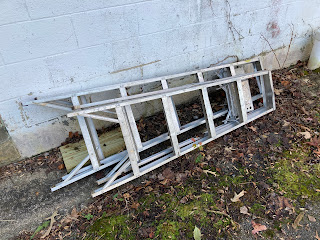
Aluminum Ladders and "The Elements"


 This short post, as a tough year nears its end, may be a valuable one for anyone with an aluminum ladder.

The two examples pictured will soon go to the metal recycler, though they look fine. Why? They've been exposed too long to heat and cold, and for aluminum ladders, as we recently learned, that can mean failure. The shorter of the two began flexing dangerously where it folds.

I began to get paranoid after a 3' step ladder we'd kept outside in our hen yard broke, resulting in my wife getting a fracture. Careful inspection showed the front legs failed where a pin went through the metal, precisely where the ladder folds.

Now we are keeping all our ladders in buildings and not in the sun or exposed to freezing weather. Yet a cursory Google search reveals web sites that say storing metal ladders outdoors is fine, while others advise against it. No one in their right mind would store a wooden ladder outside, and I suppose fiberglass will degrade under UV light, too.

I took enough Physics and Chemistry classes to understand how metal expands with heat and contracts with cold. Over time, hairline cracks form in aluminum ladders, at joints of folding ladders in particular. I'm now going to inspect our folding ladders annually with a magnifying glass at each joint, and the extension ladders where the clamps lock or pivot.

You know those click-bait ads that talk about "Learn this one simple trick for..."? Well, here is one for ladders, DIYers. Get them out of the elements. I'd not leave extension ladders out, either.

Since Canada is infinitely more sensible than the US, advice from Canadian agencies on ladder inspection proved easy to find and far clearer than OSHA's legalese. Check here for Canadian basics when checking both extension and folding ladders. Werner Ladder has a YouTube video here.

Life is short enough as it is. No need to hasten the process. Get your ladders into a building.

Here's to a better 2022!

Thursday, November 4, 2021

Sometimes, Local is the ONLY Choice to Make


I recently wrote about how Big Boxes and Amazon might save the day in certain circumstances. 

Not always, and before you say "ah, the nut is contradicting himself" let's recall Emerson's dictum that "a foolish consistency is the hobgoblin of little minds."  I may be foolish, granted, but I know a bargain when I see one.

Consider a Line-O-Tronics 315 lift I inherited when we bought this house from the estate of my wife's parents. The lift is a serious piece of equipment, a model found decades ago in professional auto shops. It will lift any vehicle we own, for prosaic oil-changes and serious work on the suspension.

My editors at Hemmings Motor News get poetic in their many articles about lifts. I aspire to write for the old-car hobby, and a lift makes one a contender rather than just a dabbler. So I was delighted to have it. 

Then, a few years back, it broke.

I'd made do with another lift nearby and a grease-pit, but the time came when the other lift in our old shop was tied up, long-term, with a car being restored. I needed to fix my own darned lift. We had the hydraulic cylinder that lifts a vehicle repaired, with new seals installed, to the tune of $300. My patient brother-in-law, who will get usage rights, wrestled it into place. We got the amperage correct for running the motor, upgrading our breaker servicing the lift.

Still, the unit's pump and motor needed servicing. The arms of the lift would not rise, even without a car on them. Being addled by the ease of Amazon, I decided "let's buy a new one!" It sounds expensive to the non-gearhead, but $400 for a motor and pump is not a big deal as replacing a lift would cost many thousands for something comparable to the old unit.

Then the shortcomings of algorithms, trans-Pacific supply chains, and infinite marketplaces reared their heads. Amazon features dozens of motors and hydraulic pumps, almost all Chinese built, but some of them do not note the dimensions of the units. That won't fly, as I've only a few spare inches of clearance when installing a new motor and fluid tank. 

Incidentally, the installation is no harder than many simple jobs, but the unit is heavy. So I asked Amazon's seller to tell me the specs for the unit I was ready to buy.

Crickets. I asked a public question and got an automated response in 48 hours saying, more or less, "no one has answered your question and that means it probably won't ever be answered."

To hell with Amazon. I started thinking that the old unit might be repairable.

I found Hesco, a local hydraulics firm, calling them about the repair. I got a live and friendly human on the phone, and I got assured they'd fix the thing if they could. I might be out $90 if it could not be repaired.

I hauled the motor and pump to them yesterday. Today I got a call: fully repaired for $106. 

Now I ask you this: should Amazon still be our first choice for every serious purchase?  

Jeff Bezos does not like to hear things like that, but maybe we should start saying such things more often. If Bezos can send William Shatner to the verge of space, he can set up a system that makes a seller give us the dimensions of an item we are to purchase.


Friday, August 20, 2021

Keep a Lid on it! The Right Lid.

Tattler reusable lids at work

My year in the garden has been "interesting," as in five Copperhead snakes in with our animals or at my feet, suddenly.

I thought my post would be about snakes, but there's something far more lethal in many homes: canning lids. 

We do a lot of canning every year: four gallons of Middle-Eastern tomato sauce, strawberry and fig jams, sometimes pickles. I go through a stack of lids.

During the pandemic, more than a few friends decided to try home canning. I've long extolled the virtues of the National Center for Home Food Preservation, my go-to for canning advice. Yet they are silent about something that happened to me the first time this year: cheapass canning lids.

In the Fall, a massive shortage of lids emerged. It might have been the prior President's stupid trade war with China, with its associated bottlenecks. It might have simply been demand. In consequence, I bought a bunch of lids from Amazon, and several in each batch this year have "buckled."  Read more about the phenomenon here. The food is still good, but the jars must be processed again or put in the refrigerator.

Buckled lids. Re-processed with Tattlers

Eating from such a jar after it has sat on a shelf a while? It might prove fatal. 

I'm relegating my cheapass Chinese bargain lids to the storage of dehydrated foods in mason jars I keep in our freezer, for stockpiling dry beans, lentils, rice, and other staples with an oxygen-absorber pack. For canning? I'm again experimenting with US-made Tattler reusable lids. I've had some for a while, and I found that when one follows their directions exactly, they work wonderfully for up to a year (I usually eat my canned food by then). Some users of the lids complain about them not sealing, but I suspect they don't read directions well. We have yet to have a problem.


My other fall back? Paying high prices to get a couple of boxes of Ball-brand lids. They have yet to fail me and though the Muncie, Indiana plant has closed, the products are still made in the US and Canada. They will be there if the Tattlers disappoint.

Does all this rage matter? Yes, and not for geopolitical reasons. The Chinese lids are often lower quality, and there are reports (well, it's the Internet) of scam-lids made to look like Ball lids but made to lower standards in China.

So spend a few more bucks on a trusted product. Boutulism? Now that is expensive.

Tuesday, August 17, 2021

Local is Not Always Good.


Readers, can you believe I wrote that? Recently I’ve had an experience with a store I praised here before, Pleasants hardware. In several cases they have stopped carrying items that I need for the farm and I’ve had to resort to Amazon, Home Depot, or Lowe’s.

What’s up? I would pay a buck or two more to support a local business, but when, in three cases, Amazon or a big box had what I needed that day and at a competitive price, I did not hesitate to buy there, especially when shipping is free via my Prime account.

Luckily, we have more than a few local options still in business.  A little hardware store called Lacy‘s in Goochland County had some security system batteries Pleasants no longer carries, and these cost half what Amazon charges. So I drove up there and got them today. We also bought a Speed Queen washer from Lacy’s during the pandemic, when all our other options were out of stock. 

Check before you buy, too. An amazing lumber yard called Siewers (pictured above) provided high quality beaded-board ceiling and paneling for a new project here, and every employee, from the counter guy to the loader, was knowledgeable and courteous. The product is superior to any millwork from a chain store. 

 I think if local places want to stay in business, they need to really provide the best customer service around, something that may not be easy to do during the pandemic. The woman who answered the phone at Pleasants today said “hello Kroger‘s.“ That greeting spoke volumes; Pleasants is now hiring anyone with a pulse.

What is to be done? Tell the local place. I told the manager at Pleasants, as politely as I could, “what you don’t carry now I ordered on my iPhone from Amazon,  while standing in aisle 7.”  

I got the item the next day. That manager is gone now. 


Delayed Gratification and Wasted Money

I hate gambling. I think it preys upon the poor and the impulsive. It reveals a deeper problem. When I saw a young man in the convenience st...